
Carbon-Positive Garden Design: Sequestering Carbon at Home
Design a carbon-positive garden that sequesters carbon through tree planting, biochar, peat-free growing, reduced hardscape, and soil health strategies.
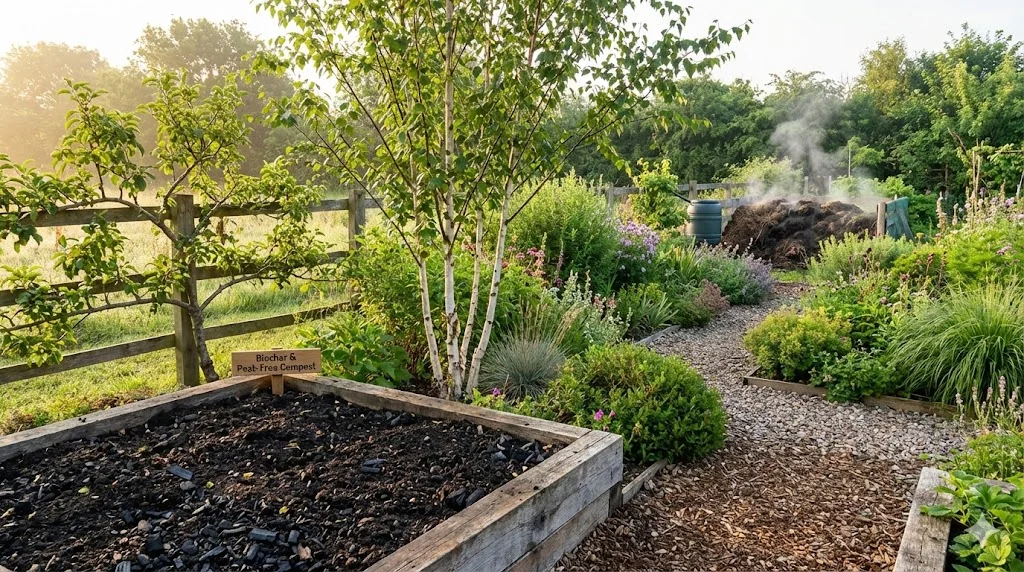
Carbon-Positive Garden Design: Sequestering Carbon at Home
Every garden has a carbon balance sheet. On one side, the emissions: energy used for mowing, the embodied carbon in concrete paving, the transport miles of imported plants and materials, the peat extracted from bogs. On the other side, the sequestration: carbon absorbed by trees, stored in healthy soil, locked into woody biomass, captured by photosynthesis and channeled down through roots into the earth.
A carbon-positive garden is one where the sequestration side of the ledger exceeds the emissions side — where your outdoor space is actively removing more carbon from the atmosphere than it adds. This is not a theoretical ideal. It is achievable in gardens of any size through deliberate design choices: planting trees, building healthy soil, using biochar, choosing peat-free products, and reducing the carbon intensity of your materials and maintenance.
This guide covers the practical steps to designing a garden that is not just sustainable but regenerative — a space that heals the climate while being beautiful and enjoyable.
Understanding Your Garden's Carbon Footprint
Before you can go carbon-positive, it helps to understand where garden emissions come from:
Carbon Sources in Gardens
- Hardscape: Concrete, cement, and new quarried stone carry significant embodied carbon. A typical patio can represent over a tonne of CO2 equivalent.
- Peat: Extracting peat releases carbon stored over millennia. Using peat-based compost directly contributes to climate change.
- Imported materials: Stone shipped from overseas, plants grown in heated glasshouses abroad, and plastic products all carry transport and manufacturing emissions.
- Power tools: Petrol mowers, leaf blowers, hedge trimmers, and strimmers burn fossil fuels directly.
- Synthetic chemicals: The manufacture and transport of synthetic fertilisers, herbicides, and pesticides all carry carbon costs.
- Soil disturbance: Digging and rotavating expose soil carbon to the air, where it oxidises and returns to the atmosphere as CO2.
Carbon Sinks in Gardens
- Trees: A single tree can absorb 20 to 50 kg of CO2 per year, depending on species and growth rate.
- Soil organic matter: Healthy soil is one of the planet's largest carbon stores. Adding organic matter annually increases soil carbon.
- Woody biomass: Hedges, shrubs, and woody perennials store carbon in their tissues for years or decades.
- Biochar: Charcoal produced by pyrolysis locks carbon in the soil for centuries.
- Living roots: Growing plants pump carbon through their roots into the soil, feeding fungi and bacteria that incorporate it into stable organic matter.
"Your garden is not just a place to enjoy — it is a place to sequester. Every design decision either adds to or subtracts from the atmosphere."
Tree Planting: The Biggest Single Impact
Planting trees is the most effective action any gardener can take for carbon sequestration. Trees absorb CO2 through photosynthesis, store carbon in their wood, leaves, and roots, and contribute organic matter to the soil throughout their lives.
Choosing Trees for Carbon Sequestration
Fast-growing trees sequester carbon most rapidly in their early years, but long-lived trees store more carbon over their lifetimes. The best strategy is a mix:
Fast-growing carbon absorbers:
- Willow (Salix) — extremely fast-growing, can be coppiced for ongoing carbon capture
- Birch (Betula) — fast to establish, supports hundreds of insect species
- Alder (Alnus) — fixes nitrogen, tolerates wet soil, moderate growth rate
- Poplar (Populus) — among the fastest-growing temperate trees
Long-lived carbon stores:
- Oak (Quercus) — slow-growing but stores carbon for centuries in massive trunks
- Beech (Fagus) — long-lived and excellent for hedging (stores carbon at scale)
- Sweet Chestnut (Castanea) — fast-growing for a long-lived tree, also produces food
- Scots Pine (Pinus sylvestris) — evergreen, so photosynthesises year-round
Trees in Small Gardens
Even small gardens can accommodate trees:
- Columnar varieties: Trees like Prunus 'Amanogawa' (upright cherry) or Carpinus 'Fastigiata' (upright hornbeam) take up minimal ground space.
- Multi-stem trees: Amelanchier, birch, and hazel grown as multi-stemmed specimens are elegant and compact.
- Espaliered fruit trees: Trained flat against a wall or fence, fruit trees sequester carbon while producing food in minimal space.
- Large shrubs: In very small gardens, large shrubs like Viburnum, Cornus, and Mahonia provide woody biomass and carbon storage.
Building Soil Carbon
After trees, building soil carbon is the most significant carbon sequestration strategy available to gardeners.
How Soil Stores Carbon
Plants fix carbon from the atmosphere through photosynthesis. Some of this carbon is transported down through roots and exuded into the soil, where it feeds microorganisms that incorporate it into stable organic compounds — humus. This process, called soil carbon sequestration, can lock carbon in the soil for decades to centuries.
Practices That Build Soil Carbon
- Add compost annually: Every time you add compost to your borders, you are adding carbon to the soil. Over years, this accumulates into significant quantities.
- Practice no-dig: Avoiding soil disturbance prevents the oxidation of existing soil carbon. No-dig gardens build carbon steadily over time. See our guide on composting and soil health.
- Mulch generously: Organic mulches (bark, wood chips, leaf mould) add carbon to the soil surface, where organisms gradually incorporate it.
- Grow cover crops: Green manures (clover, phacelia, rye) grown over bare soil in winter fix carbon through their roots and prevent erosion.
- Maintain living roots year-round: The more months of the year that living roots are active in your soil, the more carbon is being pumped underground. Perennial planting maintains roots year-round; annual crops leave soil bare and rootless for months.
Quantifying Soil Carbon
Research suggests that well-managed garden soil can sequester 0.5 to 1 tonne of CO2 equivalent per hectare per year. For a typical 200 square metre garden, this translates to 10 to 20 kg of CO2 per year through soil management alone — modest individually, but significant when multiplied across millions of gardens.
Biochar: Locking Carbon for Centuries
Biochar is charcoal produced by the slow, oxygen-limited burning (pyrolysis) of organic matter — wood, prunings, straw, or other biomass. When added to soil, biochar locks carbon in a stable form that persists for hundreds to thousands of years.
How Biochar Works
- Carbon stability: Unlike compost, which eventually decomposes and re-releases some carbon, biochar is highly resistant to decomposition. The carbon it contains is effectively permanent.
- Soil improvement: Biochar improves soil structure, increases water retention, and provides habitat for beneficial soil microorganisms.
- Nutrient retention: The porous structure of biochar holds nutrients in the root zone, reducing leaching and the need for fertiliser.
Using Biochar in the Garden
- Source or make biochar: Purchase from a reputable supplier, or make your own using a top-lit updraft (TLUD) stove or kiln from prunings and woody waste.
- Charge the biochar: Before adding to soil, soak biochar in compost tea, liquid feed, or a compost-biochar blend for several weeks. Uncharged biochar can temporarily reduce nutrient availability.
- Incorporate into soil: Mix charged biochar into the top 15 to 20 cm of soil at a rate of 1 to 5 kg per square metre.
- Add to compost: Mixing biochar into your compost bin charges it naturally and creates a supercharged soil amendment.
The Carbon Maths
One kilogram of biochar sequesters approximately 2.5 to 3 kg of CO2 equivalent. Adding 2 kg of biochar per square metre to a 50 square metre border sequesters approximately 250 to 300 kg of CO2 — the equivalent of driving 1,000 to 1,200 kilometres in a petrol car.
Going Peat-Free
Peatlands store approximately twice as much carbon as all the world's forests combined. Extracting peat for garden use releases this ancient carbon into the atmosphere and destroys irreplaceable wetland ecosystems.
Why Peat-Free Matters
- Carbon emissions: Peat extraction releases millions of tonnes of CO2 annually worldwide.
- Habitat destruction: Peatlands are unique ecosystems supporting specialist species found nowhere else.
- Irreversibility: Peatlands take thousands of years to form. Once extracted, they are gone for practical purposes.
Peat-Free Alternatives
- Coir (coconut fibre): Good water retention, suitable for seed sowing and container growing.
- Bark-based composts: Composted bark provides excellent structure and is widely available.
- Green waste compost: Municipal green waste composted to PAS100 standard is an excellent growing medium.
- Homemade compost and leaf mould: The most sustainable option — free, local, and endlessly renewable.
- Wood fibre: A relatively new ingredient that provides good aeration and structure.
Making the Switch
Peat-free composts have improved dramatically in recent years. For most garden applications — border mulching, container growing, and soil improvement — peat-free products perform as well as or better than peat-based alternatives. Seed sowing may require some adjustment (peat-free mixes often need more frequent watering), but the learning curve is short.
Reducing Hardscape Emissions
Hardscape is often the largest single source of carbon emissions in a garden. Reducing its impact involves three strategies:
1. Reduce the Amount of Hardscape
Do you really need that much paving? Every square metre of garden converted from hard surface to planted area tips the carbon balance from emission to sequestration. Consider:
- Reducing patio size to what you actually use
- Replacing unused paths with stepping stones in planting
- Converting concrete driveways to permeable surfaces with planting
- Using living boundaries (hedges) instead of walls and fences
2. Choose Low-Carbon Materials
When hardscape is necessary, choose materials with the lowest embodied carbon:
- Reclaimed materials (near-zero additional carbon)
- Locally quarried stone (minimal transport)
- FSC-certified timber (carbon neutral if sustainably managed)
- Recycled composites (diverts waste, avoids new manufacturing)
- Permeable surfaces (reduces need for drainage infrastructure)
See our detailed guide on sustainable materials for garden hardscape.
3. Design for Longevity
Materials that last fifty years have half the lifetime carbon footprint of materials that last twenty-five. Invest in quality and durability.
Reducing Maintenance Emissions
The way you maintain your garden affects its carbon balance:
- Switch to electric or manual tools: Replace petrol mowers, trimmers, and blowers with electric or manual alternatives.
- Mow less: Reduce mowing frequency or convert some lawn to wildflower meadow. See our guide on no-mow garden design.
- Compost on site: Transporting garden waste to municipal facilities adds transport emissions. Compost at home instead.
- Avoid synthetic chemicals: The manufacture and transport of synthetic fertilisers and pesticides carry carbon costs. Build soil health naturally instead.
- Water efficiently: Pumping and treating mains water is energy-intensive. Use rainwater where possible.
Designing a Carbon-Positive Garden
When you plan your garden design, incorporate carbon-positive principles from the start:
- Maximise planting, minimise hardscape: Every square metre of living planting is a carbon sink. Every square metre of concrete is a carbon source.
- Include trees: At least one tree, ideally more. Choose a mix of fast-growing and long-lived species.
- Design for no-dig management: Plan permanent planting areas with generous mulch zones.
- Specify sustainable materials: Choose reclaimed, local, and low-carbon hardscape materials.
- Plan for composting: Include composting infrastructure in the garden design — not as an afterthought tucked behind the shed.
- Include biochar: Budget for biochar incorporation during initial soil preparation.
"A carbon-positive garden is not just a garden that does no harm — it is a garden that actively heals. Every tree planted, every compost added, every square metre converted from concrete to living soil moves the needle in the right direction."
Calculating Your Garden's Carbon Balance
A rough carbon balance for a typical 200 square metre garden making carbon-positive changes:
Annual sequestration:
- Two established trees: 40 to 100 kg CO2/year
- Soil carbon building (compost, no-dig): 10 to 20 kg CO2/year
- Biochar (initial application): 250 to 300 kg CO2 (one-time, permanent)
- Hedge and shrub biomass: 5 to 15 kg CO2/year
Annual emissions (low-carbon management):
- Electric mowing: 2 to 5 kg CO2/year
- Material replacement/maintenance: 10 to 20 kg CO2/year
- Water use: 5 to 10 kg CO2/year
Net balance: Significantly carbon-positive, especially after the first few years as trees mature.
Getting Started
Three actions to begin your carbon-positive journey:
- Plant a tree this season. Even one tree begins the process of meaningful carbon sequestration. Choose a native or multi-purpose species suited to your space.
- Switch to peat-free compost. This single purchasing decision protects one of the planet's most important carbon stores. Make it permanent.
- Add biochar to one border. Purchase or make biochar, charge it with compost tea, and incorporate it into the soil. The carbon is locked in for centuries.
A carbon-positive garden is within reach of every gardener. It does not require radical changes or expensive investments — just a shift in priorities toward practices that sequester rather than emit. The result is a garden that is not only beautiful and productive but actively contributing to a stable climate. For the complete sustainable design framework, visit our sustainable garden design guide.
Garden Design Team
Expert garden designers sharing tips, inspiration, and practical advice for creating beautiful outdoor spaces.
Explore professional garden design
Scapiera is a paid professional garden-design application. See plans for included capabilities and availability.
Join the waitlistRelated articles
Composting and Soil Health for Garden Designers
Master composting and soil health for better garden design with guidance on the soil food web, composting methods, mulch types, no-dig gardening, and more.
No-Mow Garden Design: Lawn Alternatives That Thrive
Explore no-mow garden design with lawn alternatives that thrive, including clover lawns, creeping thyme, moss gardens, meadow patches, and ground covers.
Permaculture Garden Design: Principles and Practices
Learn permaculture garden design principles and practices including food forests, guilds, zones, swales, polyculture, and closed-loop sustainable systems.