
English Garden Design: Borders, Lawns, and Roses
Create a classic English garden with sweeping herbaceous borders, immaculate lawns, and romantic climbing roses. A guide to the quintessential English garden style.
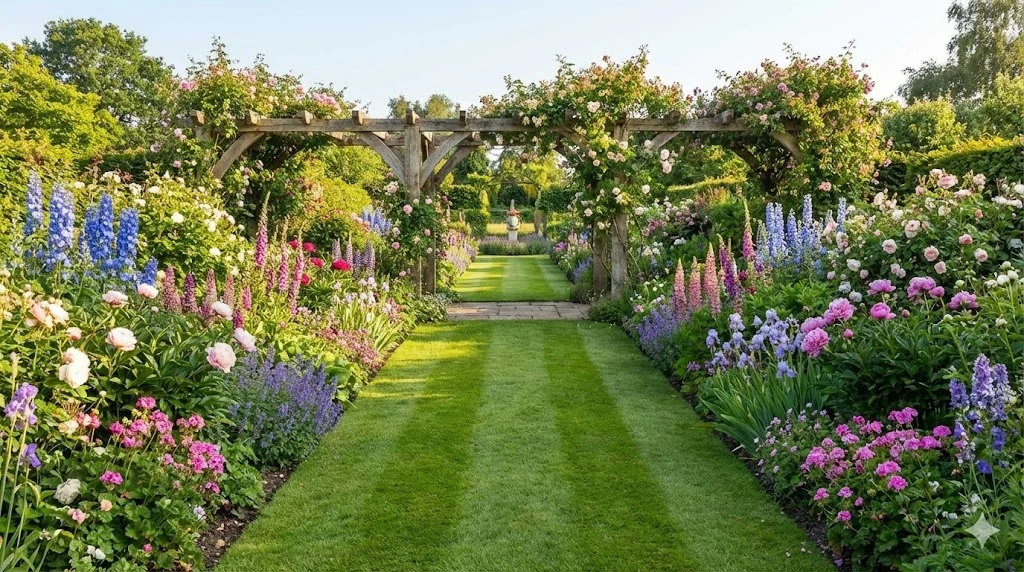
There is something deeply satisfying about stepping into an English garden in full summer bloom. Deep borders billow with delphiniums and roses, a striped lawn stretches between them like a green river, and the scent of honeysuckle drifts from a pergola draped in climbing roses. This is the quintessential English garden style, a tradition shaped by centuries of plantsmen and women who understood that great gardens are built layer by layer, season by season.
English garden design is not about rigid formality or minimalist restraint. It is about creating a generous, textured landscape where plants are the stars and structure serves as a quiet backbone. Whether your plot is a sweeping country estate or a modest suburban rectangle, the principles of herbaceous borders, well-kept lawns, and romantic rose planting can be adapted to suit any space.
The Herbaceous Border: Heart of the English Garden
The herbaceous border is the single most defining feature of English garden design. Popularised by Gertrude Jekyll in the late nineteenth century and perfected at gardens like Great Dixter and Sissinghurst, the deep, richly planted border remains the gold standard for garden planting across the world.
A true herbaceous border is planted exclusively with perennials that die back in winter and return each spring. In practice, most modern English borders are mixed borders, combining herbaceous perennials with shrubs, grasses, bulbs, and sometimes annuals to extend the season of interest and provide winter structure. Both approaches share the same underlying principle: layered planting from back to front.
The Three Layers of a Border
Understanding the back-mid-front layering system is essential for English border planting that looks natural yet carefully composed.
Back of the border (1.2 to 2 metres / 4 to 6 feet). This is where the tall, stately plants live. Delphiniums are the classic choice, their soaring blue and purple spires reaching 1.5 to 1.8 metres and creating vertical drama against a wall or hedge backdrop. Lupins in shades of pink, cream, blue, and bicolour provide similar height with a different flower form, their dense, conical spikes appearing in early summer. Hollyhocks (Alcea rosea) are another traditional choice, particularly effective when planted against a warm brick wall. Tall grasses such as Calamagrostis x acutiflora 'Karl Foerster' add movement and a contemporary edge without compromising the English character.
Middle of the border (60 cm to 1.2 metres / 2 to 4 feet). This layer does the heavy lifting in terms of volume and colour. Shrub roses, especially David Austin varieties like 'Gertrude Jekyll', 'The Generous Gardener', and 'Munstead Wood', bring fragrance, repeat flowering, and a soft, romantic form. Peonies (Paeonia lactiflora) deliver breathtaking blooms in late spring and early summer, with varieties like 'Sarah Bernhardt' and 'Bowl of Beauty' offering shades from blush pink to deep magenta. Achillea, Astrantia, Salvia nemorosa, and Phlox paniculata fill out the midsummer display, while Japanese anemones carry the border into autumn.
Front of the border (up to 60 cm / up to 2 feet). The front edge softens the transition between border and lawn or path. Hardy geraniums (cranesbills) are indispensable here, with varieties like 'Rozanne' flowering continuously from June to October. Alchemilla mollis (lady's mantle) produces a froth of lime-green flowers and scalloped leaves that spill gracefully onto paving. Nepeta (catmint), low-growing salvias, and Stachys byzantina (lamb's ears) provide texture and a silvery contrast to the richer colours behind.
Planning a Border for Succession
A common mistake in English border planting is concentrating too much colour in a single month. The best borders are planned so that something is at its peak from late April through October. Plant spring bulbs, particularly tulips and alliums, between later-emerging perennials so they provide early colour before the herbaceous plants fill in. Interplant early performers like peonies and lupins with later bloomers like echinaceas and dahlias, and use ornamental grasses to carry interest into late autumn and winter.
For a wider perspective on how the English border tradition sits alongside other planting philosophies, see our complete guide to garden design styles.
The English Lawn
No English garden is complete without a lawn. The lawn acts as a visual rest between planted areas, a surface for walking and sitting, and a design element in its own right. In the classic English garden, the lawn is not merely grass; it is a living carpet, kept dense, green, and often striped by a cylinder mower.
Creating and Maintaining a Quality Lawn
Choosing the right grass. For a traditional English lawn, a fine fescue and bent grass mixture gives the densest, finest-textured sward. If your lawn sees heavy foot traffic or family use, a blend that includes perennial ryegrass will be more durable while still looking elegant.
Mowing regime. The classic striped effect comes from a cylinder mower with a rear roller. Mow twice a week during the growing season, keeping the height at around 25 mm (1 inch) for a formal lawn or 35 to 40 mm (1.5 inches) for a lawn that also needs to tolerate some wear. Always alternate the direction of mowing to prevent the grass from developing a lean.
Feeding and aeration. Apply a balanced lawn feed in spring and a high-potassium feed in autumn to encourage root development. Aerate in autumn by spiking or hollow-tining to relieve compaction, especially on clay soils. Overseed any bare patches in early autumn when the soil is still warm and moisture is returning.
Edging. Crisp edges are what separate a good lawn from a great one. Use a half-moon edging iron to cut a clean line along borders and paths at least once a month during the growing season. The contrast between a sharp lawn edge and a billowing herbaceous border is one of the most satisfying visual effects in English garden design.
Lawn Shape and Proportion
In a traditional English garden, the lawn is typically rectangular or gently curved, running the length of the garden with borders on either side. This central green axis creates a sense of depth and draws the eye toward a focal point, whether that is a bench, a piece of statuary, or a pergola at the far end. Keeping the lawn simple in shape makes the surrounding planting feel richer by contrast.
When planning your garden layout, consider the proportions carefully. A border that is too narrow for its length will look mean and fail to create the layered depth that defines English planting. As a rule of thumb, aim for borders at least 1.5 metres (5 feet) deep, and ideally 2.5 to 3 metres (8 to 10 feet) if space allows.
Climbing Roses, Rose Arches, and Pergolas
Roses are the soul of the English garden, and nowhere are they more magical than when climbing overhead. A rose arch framing a path, a pergola dripping with scented blooms, or a rambling rose scrambling through an old apple tree: these are the moments that define the English country house garden.
Choosing Climbing and Rambling Roses
It is important to distinguish between climbers and ramblers. Climbing roses produce large flowers on a relatively stiff framework and most repeat-flower through summer. 'New Dawn' (soft pink, very reliable), 'Madame Alfred Carriere' (white, tolerates shade), and 'A Shropshire Lad' (peachy pink, David Austin) are excellent choices for arches and walls. Rambling roses are more vigorous, producing cascades of smaller flowers in a single dramatic flush. 'Paul's Himalayan Musk' and 'Bobbie James' are breathtaking on large pergolas or growing into trees, but they need space.
Rose Arches
A rose arch is one of the simplest and most effective structural elements in an English garden. Positioned over a path between two borders, it creates a sense of transition and frames the view ahead. Metal arches in powder-coated black or dark green are the most durable and unobtrusive. Plant one climbing rose on each side and train the stems horizontally along the arch to encourage flowering along the entire length rather than just at the top.
Pergolas
A pergola takes the arch concept further, creating a covered walkway or seating area draped in roses and other climbers. Traditional English pergolas are built from oak or softwood posts with sawn timber cross-beams, though metal and brick-pillared designs are also common. Plant climbing roses alternating with clematis for a longer flowering season: the clematis will bloom into late summer and autumn after the main rose flush is over.
Position a pergola to connect two areas of the garden, to lead toward a focal point, or to create a shaded sitting area with a view back over the borders and lawn. Underplant with shade-tolerant perennials like Brunnera, foxgloves, and ferns for a lush, layered effect.
The English Country House Look
The English country house garden is a specific expression of English garden design, characterised by generous scale, a seamless relationship between house and garden, and a combination of formal structure with romantic planting. Even if your home is not a Cotswold manor, you can borrow its key principles.
Symmetry softened by planting. The area closest to the house often features symmetrical beds, clipped box or yew hedging, and a central path or axis. But within this framework, the planting itself is loose and abundant: roses tumbling over low hedges, lavender lining paths, and self-seeding plants appearing in the gravel. The contrast between geometric structure and naturalistic planting is central to the English country house aesthetic.
Rooms and transitions. Larger English gardens are often divided into garden rooms, each with a different character: a formal rose garden, a wild meadow, a productive kitchen garden, a secluded pond. Hedges, walls, and arches create doorways between these rooms, building a sense of discovery and journey. Even in a smaller garden, a single arch or a change of level can suggest the idea of rooms.
Materials. Natural materials anchor the English country house garden. York stone or reclaimed brick for paths and terraces, aged oak for pergolas and benches, hand-thrown terracotta for pots. Avoid plastic and bright modern materials; the palette should feel weathered and settled, as though the garden has been there for generations.
Focal points. A stone urn on a plinth, an antique sundial, a simple wooden bench at the end of a path: well-placed focal points give the eye somewhere to rest and create a sense of purpose in the layout. These do not need to be expensive or grand. A good clay pot planted with a standard rose or a clipped bay tree can be equally effective.
For more on using formal geometry as a backbone for planting, our guide to formal garden design explores the principles of symmetry and structure in depth.
Classic Border Plants: A Closer Look
Building on the layered approach described above, here is a more detailed look at the plants that define the English herbaceous border.
Delphiniums
The aristocrat of the English border. Pacific hybrids and elatum types produce the tallest spikes in shades of true blue, violet, white, and pink. Plant in rich, well-drained soil in full sun. Stake early with grow-through supports. Cut back after flowering and feed to encourage a second, shorter flush in late summer.
Lupins
Lupinus hybrids bring bold colour in early summer. The 'Gallery' and 'Band of Nobles' series offer compact to tall forms in a wide colour range. Lupins prefer slightly acidic to neutral soil and dislike heavy clay. They are short-lived perennials but self-seed freely, creating natural drifts over time.
Roses in the Border
Shrub roses planted within the herbaceous border, rather than in a dedicated rose bed, is a hallmark of modern English garden design. Varieties with an arching, natural habit integrate far better than stiff hybrid teas. Choose repeat-flowering types and underplant with hardy geraniums or nepeta to mask their bare legs in midsummer.
Peonies
Herbaceous peonies are magnificent but fleeting, flowering for just two to three weeks in late spring or early summer. Their brief season is forgiven because the display is so opulent. Plant with the crown buds no more than 2.5 cm (1 inch) below the soil surface, in sun or light shade. Support with peony rings early in the season. The foliage remains attractive through summer and often colours well in autumn.
Hardy Geraniums
The workhorse of the English garden. Geranium 'Rozanne' flowers for five months or more. Geranium pratense and Geranium psilostemon offer taller, more dramatic forms. Hardy geraniums fill gaps, suppress weeds, and provide a constant hum of colour at the front and middle of the border with almost no maintenance.
Adapting English Garden Design to Small Spaces
You do not need acres to create an English garden. The principles of layered borders, a central lawn, and climbing roses scale down beautifully, provided you make some strategic adjustments.
Narrow borders, deep planting. Even a border just 1 metre (3 feet) deep can accommodate two layers if you choose plants carefully. Use a single tall delphinium or lupin at the back, mid-height geraniums and salvias in the centre, and a low edging of Alchemilla mollis or thyme at the front. The key is density: pack plants closely to create the impression of abundance.
A small lawn with purpose. A patch of fine lawn, even just 3 by 4 metres (10 by 13 feet), provides the visual breathing space that makes surrounding planting feel generous. Keep the shape simple and the edges crisp.
Vertical planting. In a small garden, walls and fences are your largest planting surfaces. Train climbing roses, clematis, and jasmine to clothe every available vertical surface. A single rose arch over the garden entrance immediately establishes the English character.
Container planting. Terracotta pots planted with standard roses, lavender, or clipped box bring English garden elements onto patios and balconies. Group pots in odd numbers and vary the heights for a natural, layered effect.
Editing the plant list. In a small space, choose fewer varieties but plant them in larger groups. Three clumps of the same geranium will read as a coherent drift; three different species in the same space will look scattered. Focus on long-flowering, multi-season plants to maximise impact from a smaller palette.
When working with compact plots, visualising the finished result before breaking ground helps you test proportions, sight lines, and planting depths without committing to expensive mistakes.
Seasonal Care Calendar
Maintaining an English garden border and lawn through the year requires attention at the right moments. Here is a simplified calendar.
Early spring (March to April). Cut back dead perennial growth. Divide congested clumps of geraniums, asters, and grasses. Apply a general-purpose feed and mulch borders with garden compost or well-rotted manure. Begin mowing the lawn on a high setting.
Late spring (May). Stake delphiniums, lupins, and peonies before they reach full height. Plant out tender annuals like dahlias and cosmos to fill summer gaps. Lower the mowing height gradually.
Summer (June to August). Deadhead roses, delphiniums, and lupins to encourage repeat flowering. Water deeply during dry spells, particularly newly planted perennials. Keep lawn edges trimmed. Cut back early-flowering geraniums hard after their first flush for fresh foliage and a second bloom.
Autumn (September to November). Plant spring bulbs among the perennials. Aerate and overseed the lawn. Plant bare-root roses and new shrubs from November. Clear fallen leaves from borders and lawn.
Winter (December to February). Plan changes and order new plants. Prune climbing roses in January, tying in new growth horizontally. Sharpen and service mowing and edging tools. Enjoy the structure of the garden: the shapes of bare shrubs, the frost on ornamental grasses, the architecture that good bones provide even when the borders are sleeping.
Bringing It All Together
English garden design is not a single recipe but a set of deeply rooted principles: plant generously, layer from back to front, balance structure with softness, and let roses weave through it all. The herbaceous border provides colour and texture, the lawn provides calm and proportion, and the climbing roses provide romance and vertical drama. Together, they create a garden that feels both timeless and deeply personal.
Start with one well-planted border and a small, well-kept lawn. Add a rose arch or a simple pergola. Choose a handful of classic plants and learn to grow them well. Over the seasons, your garden will knit together into something that feels as though it has always been there, which is the highest compliment any English garden can receive.
For more inspiration on planting styles that complement or contrast with the English tradition, explore our guides to cottage garden design and the broader overview of garden design styles.
Garden Design Team
Expert garden designers sharing tips, inspiration, and practical advice for creating beautiful outdoor spaces.
Explore professional garden design
Scapiera is a paid professional garden-design application. See plans for included capabilities and availability.
Join the waitlistRelated articles
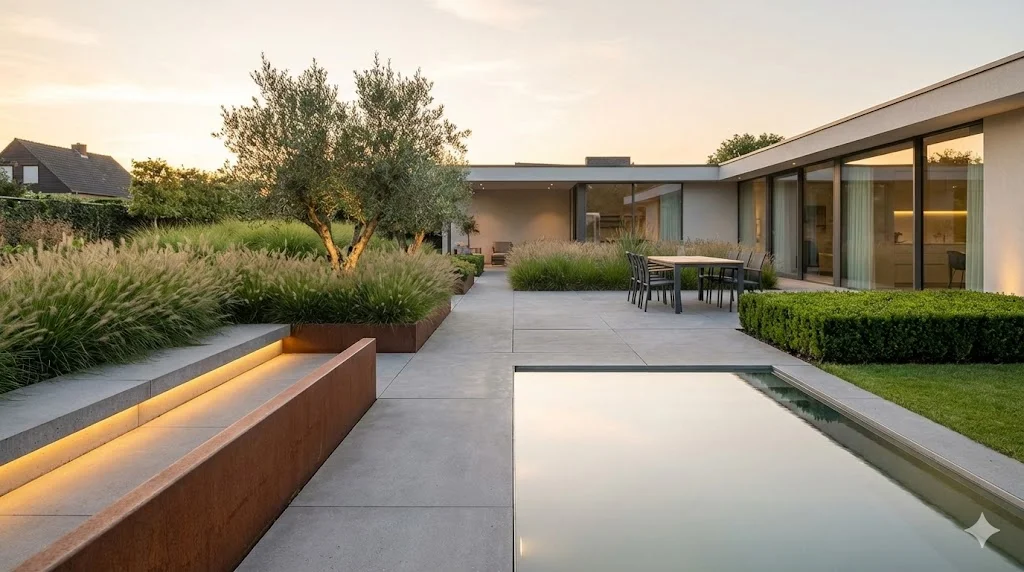
Garden Design Styles: The Complete Guide
Explore every major garden design style from cottage to Japanese, modern to Mediterranean. Find the perfect style for your space, climate, and taste.
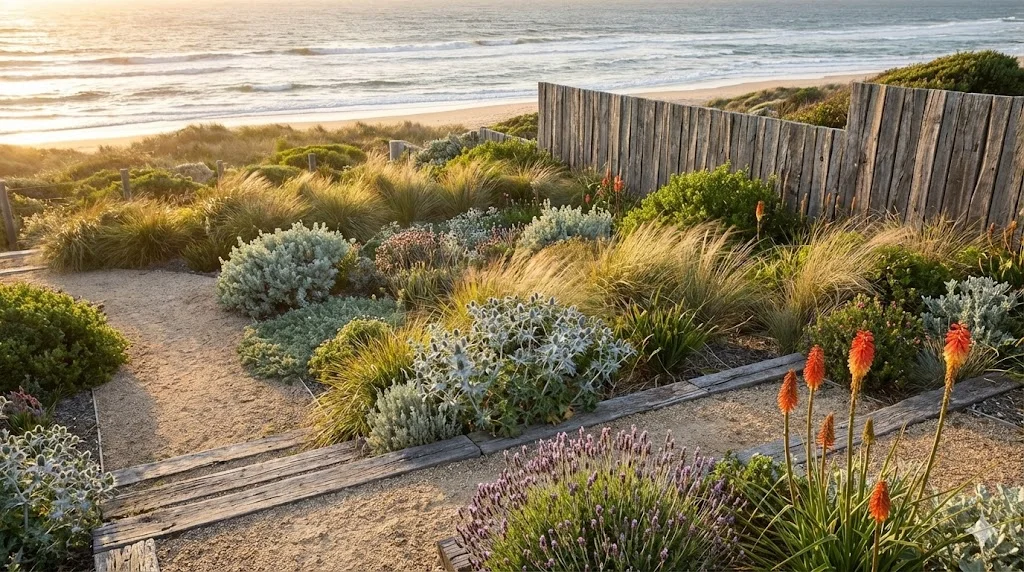
Coastal Garden Design: Salt-Tolerant Beauty
Design a beautiful coastal garden that thrives in salt spray, wind, and sandy soil. Discover the best seaside garden plants and design techniques for exposed sites.
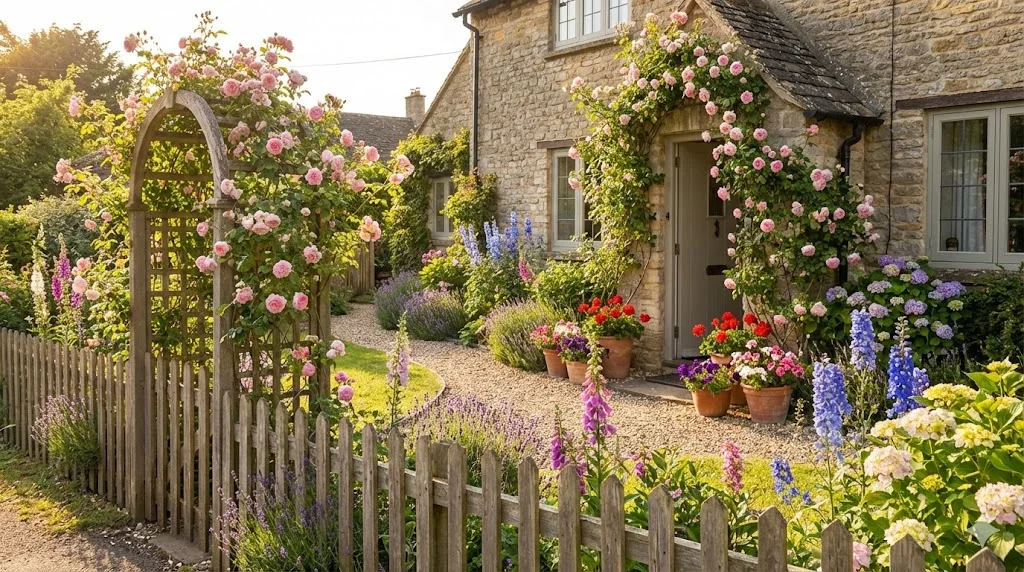
Cottage-Style Front Garden: Welcoming and Colorful
Transform your front garden into a welcoming cottage paradise with climbing roses, flower-lined paths, and seasonal color. Design tips for maximum curb appeal.