
Gravel Garden Design: Low-Maintenance and Drought-Tolerant
Create a beautiful gravel garden inspired by Beth Chatto's pioneering approach. Discover drought-tolerant plants, self-seeding techniques, and minimal maintenance.
Gravel Garden Design: A Complete Guide to Low-Maintenance, Drought-Tolerant Planting
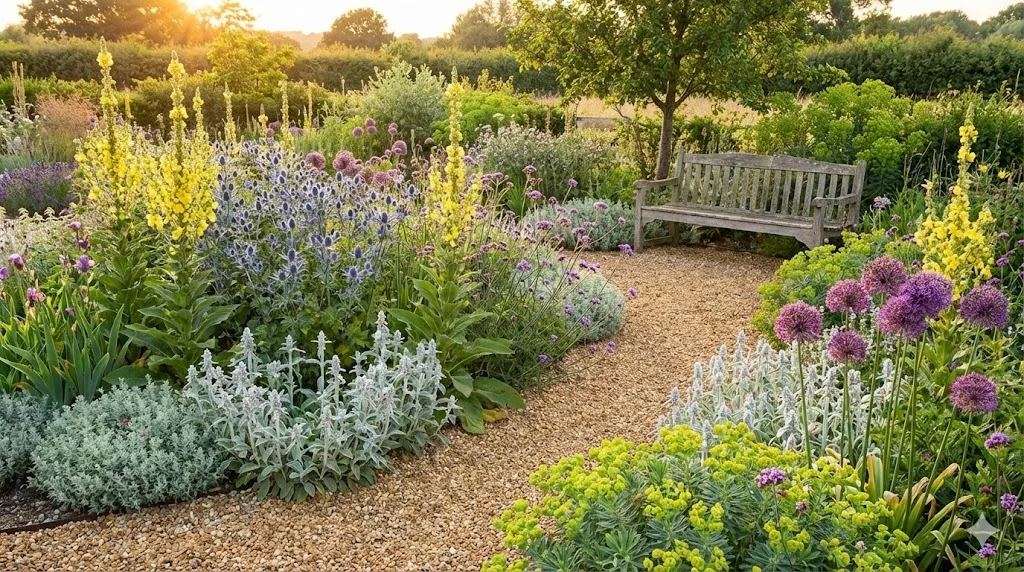
Few garden styles reward patience and restraint as generously as the gravel garden. Picture tall spires of verbascum rising from a carpet of pale stone, allium drumsticks catching the evening light, and self-sown verbena bonariensis threading its way through drifts of silvery stachys. This is a garden that looks after itself — a place where plants find their own positions, seed where they are happiest, and create combinations that no designer could have planned.
Gravel garden design is rooted in a simple, powerful idea: work with your conditions rather than against them. Instead of fighting dry soil, poor nutrients, and baking sun, you embrace them. The result is a garden that needs no irrigation, minimal feeding, and almost no weeding once established — and yet overflows with color, texture, and wildlife from spring through to the first frosts.
For a wider view of how gravel gardens sit alongside cottage, Mediterranean, Japanese, and other approaches, explore our complete guide to garden design styles.
Beth Chatto's Pioneering Legacy
No conversation about gravel garden ideas can begin without Beth Chatto. In 1991, she ripped up a disused car park at her nursery in Elmstead Market, Essex — compacted gravel over heavy clay — and set out to prove that a garden could thrive without any irrigation at all. Essex receives less annual rainfall than Jerusalem. The soil was hopeless by conventional standards.
Her approach was deceptively simple. She chose plants from the world's dry habitats — the Mediterranean maquis, the Central Asian steppe, the South African veld — and planted them in conditions that mimicked their homelands. Deep gravel mulch kept roots cool and crowns dry. Lean soil discouraged floppy growth and produced compact, resilient plants that could endure months without rain.
What made Chatto's garden revolutionary was not just survival — it flourished. Plants self-seeded freely, finding their own niches. Verbascum appeared in cracks near paths. Alliums colonized open patches. The garden developed an ecological momentum Chatto described as "the garden gardening itself." Her books — particularly The Dry Garden and Beth Chatto's Gravel Garden — remain essential reading for anyone drawn to this style.
Core Principles: Dry, Lean, and Self-Sustaining
A gravel garden is not a conventional border with stones scattered on top. It is a fundamentally different approach built on three principles.
Sharp drainage and low fertility. Most gravel garden plants evolved in nutrient-poor soils. Rich conditions produce weak, leggy growth that rots at the crown. Keeping soil lean encourages deep roots, compact form, and the sturdy architecture that defines this style. No compost, no fertilizer, no watering once established — counterintuitive, but the results speak for themselves.
Self-seeding as a design strategy. In a traditional garden, self-seeding is a nuisance. In a gravel garden, it is the engine of the design. You plant the founding population and let nature arrange. Self-sown plants choose better positions than you would — germinating where drainage, light, and shelter are exactly right. The skill lies in editing: keeping seedlings that strengthen the design and removing those that crowd.
Gravel as living mulch. The gravel suppresses weeds, moderates soil temperature, reduces evaporation, and provides the perfect germination medium for desirable self-seeders. Unlike organic mulch, it does not break down, harbor slugs, or add unwanted fertility.
Site Preparation
Good preparation is the most important investment. Get it right and the garden looks after itself for decades.
Removing Turf and Weeds
Smothering: Cover the area with thick cardboard for six to twelve months. Gentle on soil but requires patience. Stripping turf: Faster — use a spade to remove the top layer of grass. Leaner soil is what you want, so removing topsoil is no loss here.
The critical step is eliminating perennial weeds — bindweed, couch grass, ground elder. These exploit gravel mulch mercilessly. Dig out every root fragment before planting.
Membrane: Yes or No?
Beth Chatto never used membrane, and most purists agree. It prevents self-seeding, blocks soil organisms, and degrades into ugly fragments. However, membrane works well under paths and seating areas where you want weed-free gravel without plants. The practical compromise: membrane under paths, bare soil under planting areas.
Drainage on Clay
If your soil is heavy clay, dig in coarse grit at roughly one part grit to two parts soil. This prevents winter waterlogging, which kills more drought-tolerant plants than cold ever does. Sandy or chalky soil? Simply clear weeds and proceed.
Choosing Gravel
Types: Pea gravel (rounded, 10-20mm / 3/8-3/4 inch) is the classic choice for planting areas — comfortable underfoot and easy for seedlings to root through. Angular gravel locks together better for paths. Hoggin (self-binding gravel) compacts into firm surfaces for high-traffic areas.
Color: Warm tones — honey, buff, pale ochre — complement silver and green foliage beautifully. Local stone is almost always the best choice, tying the garden to its landscape.
Depth: 5-8 cm (2-3 inches) for planting areas; 8-10 cm (3-4 inches) for paths over membrane.
Essential Plants for the Gravel Garden
The plant palette is where gravel garden design becomes irresistible. When you begin planning your planting layout, grouping by height, texture, and season ensures year-round interest.
Verbascum (Mullein). The signature gravel garden plant. V. bombyciferum produces felted silver rosettes then sends up 1.8 m (6 foot) spires of yellow. V. chaixii 'Album' offers white flowers with mauve eyes. Short-lived but self-seeds prolifically.
Alliums. Allium hollandicum 'Purple Sensation' produces violet-purple spheres on 90 cm (3 foot) stems. A. cristophii offers larger starburst heads. Dried seedheads persist for months of sculptural interest.
Euphorbia. The backbone of the gravel garden — tough, structural, evergreen. E. characias subsp. wulfenii forms imposing domes topped with lime-green flower heads. E. myrsinites sprawls over gravel with trailing blue-grey stems.
Eryngium (Sea Holly). E. giganteum (Miss Willmott's Ghost) self-seeds with abandon, producing statuesque silver-blue cones. E. bourgatii is a reliable perennial with electric-blue flowers and silver-veined leaves.
Stachys byzantina (Lamb's Ear). Thick, felted, silver-white leaves form dense mats — perfect for path edges. The non-flowering 'Silver Carpet' is popular for foliage alone.
Verbena bonariensis. Tall, wiry stems and purple flower clusters create a see-through haze at eye level from midsummer to frost. Self-seeds freely. Butterflies adore it.
Supporting cast: Gaura lindheimeri (airy white wands), Perovskia (lavender-blue clouds), Stipa tenuissima (shimmering ponytail grass), Centranthus ruber (self-seeding red valerian), and Erigeron karvinskianus (tiny daisies colonizing every crevice).
Self-Seeding Ecology
Seeds germinate in gravel because the stones trap dew, moderate temperature swings, and protect seedlings during their first critical days. Over time, distinct communities emerge — sun-lovers in open areas, shade-tolerant species in the lee of larger clumps, moisture-lovers drifting toward low points where rain briefly collects.
Your role shifts from creator to editor. Each spring, walk the garden with a keen eye and a sharp hoe. Keep seedlings that fill gaps or introduce unexpected combinations. Remove those that crowd. This annual edit is one of the great pleasures of gravel gardening — a creative conversation between you and the garden.
Seasonal Succession
Spring: Euphorbias push up acid-green flower heads. Alliums rise through emerging foliage. Species tulips, crocus, and muscari thrive in gravel where dry summer dormancy is naturally met.
Summer: The crescendo. Verbascum spires in full sail, eryngiums turning electric blue, verbena bonariensis beginning its purple haze. The garden buzzes with pollinators.
Autumn: Dried seedheads of allium, eryngium, and verbascum become sculptural features in low sunlight. Sedums deepen to russet. Perovskia carries color into October.
Winter: Do not cut back too early. Seedheads rimmed in frost are magical. Evergreen euphorbias and stachys maintain structure. The gravel itself, wet and glinting in low light, becomes a feature.
Combining Gravel with Paths and Courtyards
The contrast between disciplined hard landscaping and relaxed, self-sowing plants is one of the most effective tensions in garden design. A straight stone path through billowing gravel planting creates a strong axis while erigeron and stachys soften the edges naturally.
Gravel courtyards work particularly well as front gardens — replacing water-hungry lawns with something that looks better and costs nothing to maintain. If the courtyard approach appeals, the principles overlap significantly with Mediterranean garden design, which shares the same love of gravel, stone, and drought-tolerant planting.
Use clean edging — metal, stone setts, or brick — to prevent gravel migrating into neighboring surfaces.
Maintenance Calendar
Early spring (March-April): Cut back last year's stems. Hoe unwanted seedlings. Assess gaps. Plant new additions.
Late spring (May): Continue editing seedlings. Top up gravel around plant crowns. Water only newly planted additions.
Summer (June-August): Deadhead only to reduce specific self-seeders. Pull the few annual weeds that appear. Enjoy the garden.
Autumn (September-November): Resist tidying. Leave seedheads for winter interest and wildlife. Collect seed from favorites for specific locations.
Winter (December-February): Leave the garden alone. Plan spring additions. Spread gravel where paths have worn thin.
Gravel Gardens and Water-Wise Design
Gravel gardens sit at the intersection of beauty and responsibility. In an era of increasing drought and pressure on water supplies, a garden that needs no irrigation is not merely stylistic — it is practical. If you garden in a particularly hot, arid climate, our guide to desert and xeriscape garden design extends these ideas into even drier conditions.
What Beth Chatto proved in that unpromising Essex car park has only become more relevant: a garden designed to work with nature rather than against it is not a compromise. It is a liberation.
Getting Started
Start small. A single bed or front garden with five or six well-chosen species — a verbascum, an allium, a euphorbia, an eryngium, a stachys, and a verbena bonariensis — planted into unamended soil and mulched with gravel will teach you more than any book.
Within a season the plants settle. Within two they begin to self-seed. Within three you have a garden that looks decades old — one that waters itself, weeds itself, and designs itself. When you are ready to plan your full planting scheme, translating that first sketch into a detailed layout helps you see exactly how each season will unfold before a single plant goes into the ground.
That is the extraordinary promise of the gravel garden. It asks less of you than any other style, and in return gives you something no amount of effort could manufacture: a garden that feels completely, effortlessly alive.
Garden Design Team
Expert garden designers sharing tips, inspiration, and practical advice for creating beautiful outdoor spaces.
Explore professional garden design
Scapiera is a paid professional garden-design application. See plans for included capabilities and availability.
Join the waitlistRelated articles
Garden Design Styles: The Complete Guide
Explore every major garden design style from cottage to Japanese, modern to Mediterranean. Find the perfect style for your space, climate, and taste.
Coastal Garden Design: Salt-Tolerant Beauty
Design a beautiful coastal garden that thrives in salt spray, wind, and sandy soil. Discover the best seaside garden plants and design techniques for exposed sites.
Cottage-Style Front Garden: Welcoming and Colorful
Transform your front garden into a welcoming cottage paradise with climbing roses, flower-lined paths, and seasonal color. Design tips for maximum curb appeal.