
French Garden Design: Formal Elegance
Master the art of French garden design with parterre patterns, gravel allées, and Versailles-inspired symmetry. Create formal elegance in any size garden.
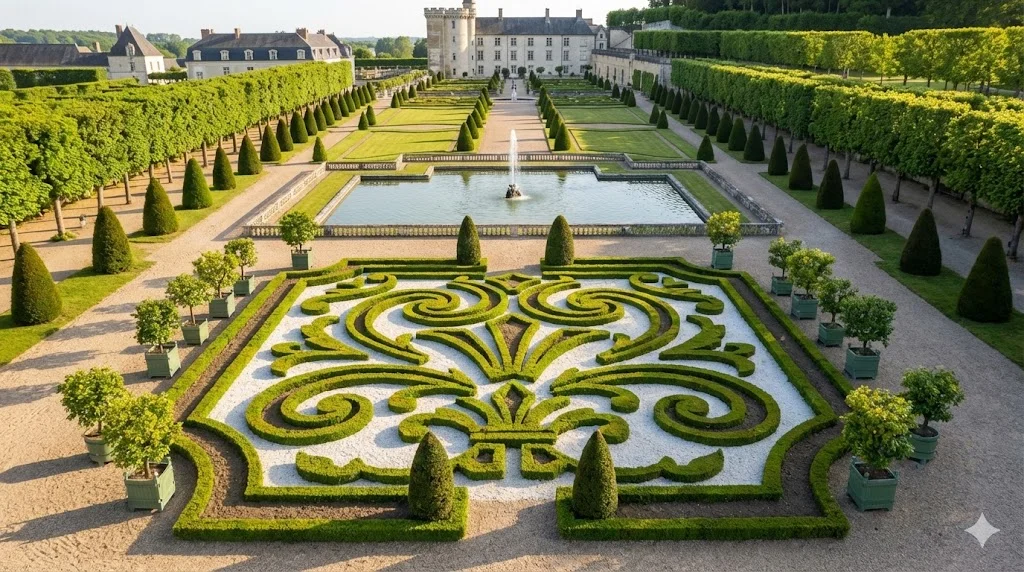
There is no garden tradition on earth quite as commanding as the French formal garden. Born in the grand châteaux of the Loire Valley and perfected at Versailles under André Le Nôtre, French garden design treats the landscape as living architecture — a place where geometry, perspective, and the patient art of clipped hedging transform open ground into rooms of green and gravel. The parterre de broderie, the gravelled allée vanishing toward a distant fountain, the precision of box scrollwork against pale stone — these images have shaped garden-making for more than three centuries.
Yet French garden design is not confined to palaces. The same principles that govern a hectare of parterre at Vaux-le-Vicomte can bring elegance to a modest courtyard or a suburban front garden. This guide explores the foundations of the French formal style and shows how to apply them at every scale.
The Three Pillars: Geometry, Symmetry, and Perspective
Every French formal garden rests on three interlocking principles.
Geometry provides the grammar. Where the English landscape tradition celebrates curves, the French garden embraces the straight line, the circle, and the arc. Beds are geometric. Hedges run in ruled lines. Paths meet at right angles or radiate from a central point in a patte d'oie (goose foot) pattern. The geometry is established first with hard materials — gravel, stone edging — and then reinforced by clipped box or yew hedging that turns living plants into architectural lines.
Symmetry creates repose. French formal gardens are almost always bilaterally symmetrical: the left side mirrors the right across a strong central axis. Two matching rows of pleached limes, two identical parterre panels, two flanking fountains — the repetition tells the visitor that every line has been drawn with intention.
Perspective extends the space. Le Nôtre's genius was manipulating how distance reads. At Versailles, allées narrow as they recede, topiary grows taller toward the horizon, and water features reflect the sky to double the garden's visual depth. Even in a small garden, a tapering path or a focal point on the farthest boundary creates the illusion that the garden is larger than it is.
For a broader look at how French formality sits alongside cottage, Japanese, Mediterranean, and other approaches, see our complete guide to garden design styles.
The French Parterre: Embroidery in Hedging
The parterre is the signature feature of French garden design — a flat area divided into ornamental beds by low clipped hedging, best viewed from a terrace or upper window.
Parterre de Broderie
The most celebrated form is the parterre de broderie — literally, "embroidery parterre." Dwarf box (Buxus sempervirens 'Suffruticosa') is trained into flowing, scrolling patterns resembling lacework. The infill between the hedging lines is crushed stone or fine gravel in a contrasting colour — white marble chips, pale limestone, or brick dust in terracotta. The contrast between dark green hedging and pale ground is what makes the pattern legible.
The best broderie patterns are continuous (lines never dead-end), symmetrical across at least one axis, and scaled so individual hedge sections are practical to clip — runs of one to three metres work best. For intricate designs, it helps enormously to draw the pattern to scale before committing a single plant to the ground.
Parterre de Compartiment
Simpler than broderie but still unmistakably French, the parterre de compartiment uses geometric shapes — squares, circles, lozenges — arranged around a central fountain or specimen tree. The beds may hold seasonal flowers, herbs, or low perennials edged in box or santolina. A pair of rectangular beds flanking a central gravel path, each subdivided into quarters with low hedging, is a complete compartiment in miniature.
Plant hedging at close spacing — 12 to 15 centimetres (5 to 6 inches) apart for dwarf box, 20 to 30 centimetres (8 to 12 inches) for yew — and keep it low: 20 to 40 centimetres (8 to 16 inches) is typical for a broderie parterre.
Box and Yew: The Green Architecture
Clipped hedging is the material from which a French garden's architecture is built. Dwarf box has been the parterre plant of choice since the sixteenth century, though box blight and the box tree moth have driven many gardeners toward alternatives: Ilex crenata (Japanese holly), Euonymus japonicus 'Green Spire', and Lonicera nitida all produce tight geometric lines.
For taller hedging and topiary, yew (Taxus baccata) is supreme — dense, dark, and tolerant of hard pruning. A yew hedge clipped flat on top is as architectural as masonry, and it regenerates from bare wood, something few evergreens can do. Clip once or twice a year, feed after clipping, and water during drought.
Topiary serves as punctuation: pairs of clipped cones or spheres flank gateways and mark parterre corners. Standard-form plants in Versailles tubs — the square slatted planters named for the Orangerie — are particularly characteristic, and can be moved seasonally or overwintered under cover.
Allées and Gravel Paths
An allée is a formal walk bordered by evenly spaced trees — pleached limes, hornbeam, or plane trees — that draws the eye toward a terminus. In smaller gardens, pleached hornbeam or crab apple on a framework achieves the same effect at domestic scale.
Gravel is far more than a practical surface in French garden design. The vast gravel courts at Versailles are as integral to the composition as the parterres themselves. Choose pale, warm-toned gravel — limestone or sandstone in cream or buff — and edge it crisply with stone kerbs or steel to maintain clean lines. Self-binding gravel compacts to a firm surface for main paths; loose gravel works best for decorative parterre infill.
Rake regularly, apply a pre-emergent weed preventer in spring, and top up every two to three years as material compacts and migrates.
Water Features: Fountains, Canals, and Basins
Water introduces light, sound, and reflection — a living counterpoint to the stillness of hedging and gravel.
Fountains anchor the intersection of axes. In smaller settings, a single vertical jet from a round or octagonal basin is more effective than elaborate tiered designs. Position the fountain where it serves as both focal point and pivot.
Canals and rills are a distinctly French contribution. At Versailles the Grand Canal stretches 1,600 metres; at domestic scale, a narrow rill just 30 centimetres (12 inches) wide and 10 metres (33 feet) long captures much of the same magic, leading the eye and reflecting the sky.
Reflecting pools — circular, rectangular, or octagonal — double the visual depth of the garden. Keep the water level high and the interior dark for the clearest reflections.
The Orangerie Concept
The Orangerie — a south-facing building sheltering citrus, palms, and tender plants through winter — is one of the grand French garden's most distinctive features. In summer the plants are wheeled out in Versailles tubs to line the parterre, creating seasonal theatre.
Few modern gardeners can build an Orangerie, but the concept translates easily: a glazed lean-to, a heated greenhouse, or a bright frost-free garage can overwinter tender container plants that spend summer outdoors as part of the formal composition. The ritual of bringing plants out in spring and retreating them in autumn connects the gardener to the French seasonal calendar.
Adapting Versailles to a Small Garden
French garden design is scale-neutral. A courtyard of three by five metres can feel authentically French — provided proportions are right and details are disciplined.
Simplify the geometry. One strong axis and one cross-axis are enough. A central gravel path leading to a wall-mounted fountain, with matching parterre beds on either side, is a complete French garden in miniature.
Scale the hedging. Use 15 to 25 centimetre (6 to 10 inch) hedging to outline beds without overwhelming the space. Germander or dwarf lavender can substitute for box in very small parterres.
Use containers. A pair of Versailles tubs flanking a doorway instantly establishes French formality. Move them to adjust the composition seasonally.
Borrow perspective. A mirror on an end wall, a trompe-l'oeil trellis, or a borrowed view of a distant tree can terminate your axis, extending the garden visually beyond its physical limits.
When working through the proportions of a compact formal layout, planning your garden to scale lets you test the balance of beds, paths, and focal points before planting begins.
The French Potager: Where Formality Meets the Kitchen
The French potager is a kitchen garden laid out with parterre discipline. Vegetables, herbs, and cutting flowers grow in symmetrical raised beds, edged with low hedging, and arranged around a central well, sundial, or standard rose.
The most famous example is the Potager du Roi at Versailles, built in 1683 to supply the royal table. Its legacy lives on in countless kitchen gardens where beauty and productivity coexist. Carrots are sown in ruler-straight rows, lettuces planted in alternating colours, and runner beans climb identical obelisks at each bed corner.
The potager is a natural entry point for gardeners who love the French formal aesthetic but want their garden to earn its keep — the structure is the same, but the planting is edible. A parterre of herbs (thyme, sage, chives, parsley) edged in clipped box is as elegant as any ornamental bed and far more useful. If structured layouts for herbs and edibles appeal to you, our post on herb garden design and layout planning explores similar principles in detail.
Seasonal Rhythms
A French formal garden moves through the year with deliberate rhythm. Spring brings tulips and wallflowers to the parterre beds while box flushes with bright new growth. Summer is the season of roses and lavender, the garden at its most inviting after the first hedge clip. Autumn means bedding changeover and spring bulb planting, while topiary receives its final trim. Winter reveals the bones — frost outlining every tiny box leaf in white, the evergreen structure standing in full architectural clarity. This is when a well-built French garden looks its finest.
Bringing It All Together
French garden design asks the gardener to think like an architect — to draw strong lines, balance every element across the axis, and trust that restraint is more powerful than abundance. Start with the axis and the focal point. Add the parterre or paired beds. Edge with hedging, surface with gravel, and introduce water. Then plant within the structure — a limited palette, repeated with rhythm.
The French formal garden is an act of optimism. It says that order is possible, that beauty can be composed, and that a garden improves with every passing year. The hedges thicken, the gravel mellows, the fountain wears a patina of age, and the garden slowly becomes what it was always intended to be: a place where nature and intention meet in quiet, formal elegance.
For a deeper exploration of symmetry, topiary, and axial design across all formal traditions, see our guide to formal garden design: symmetry and structure.
Garden Design Team
Expert garden designers sharing tips, inspiration, and practical advice for creating beautiful outdoor spaces.
Explore professional garden design
Scapiera is a paid professional garden-design application. See plans for included capabilities and availability.
Join the waitlistRelated articles
Garden Design Styles: The Complete Guide
Explore every major garden design style from cottage to Japanese, modern to Mediterranean. Find the perfect style for your space, climate, and taste.
Coastal Garden Design: Salt-Tolerant Beauty
Design a beautiful coastal garden that thrives in salt spray, wind, and sandy soil. Discover the best seaside garden plants and design techniques for exposed sites.
Cottage-Style Front Garden: Welcoming and Colorful
Transform your front garden into a welcoming cottage paradise with climbing roses, flower-lined paths, and seasonal color. Design tips for maximum curb appeal.