
How to Choose the Right Plants for Your Garden
Discover how to choose the right plants for your garden by assessing sunlight, soil, hardiness zones, and bloom succession for year-round beauty and health.
How to Choose the Right Plants for Your Garden
Choosing plants is the most exciting part of garden design -- and the part where the most money gets wasted. A gorgeous plant in the wrong spot will sulk, struggle, and eventually die, no matter how much you paid for it. The right plant in the right place, however, will thrive with minimal intervention, growing more beautiful every year.
The secret to choosing well is not encyclopedic plant knowledge. It is understanding your garden's conditions first and then matching plants to those conditions. This guide walks you through a systematic approach that eliminates guesswork and ensures that every plant you buy earns its place. For the full garden design process, see our complete guide to designing a garden from scratch.
Audit Your Sunlight
Light is the single most important factor in plant selection. A plant that needs full sun will not flower in shade, and a shade-lover will scorch in direct afternoon sunlight.
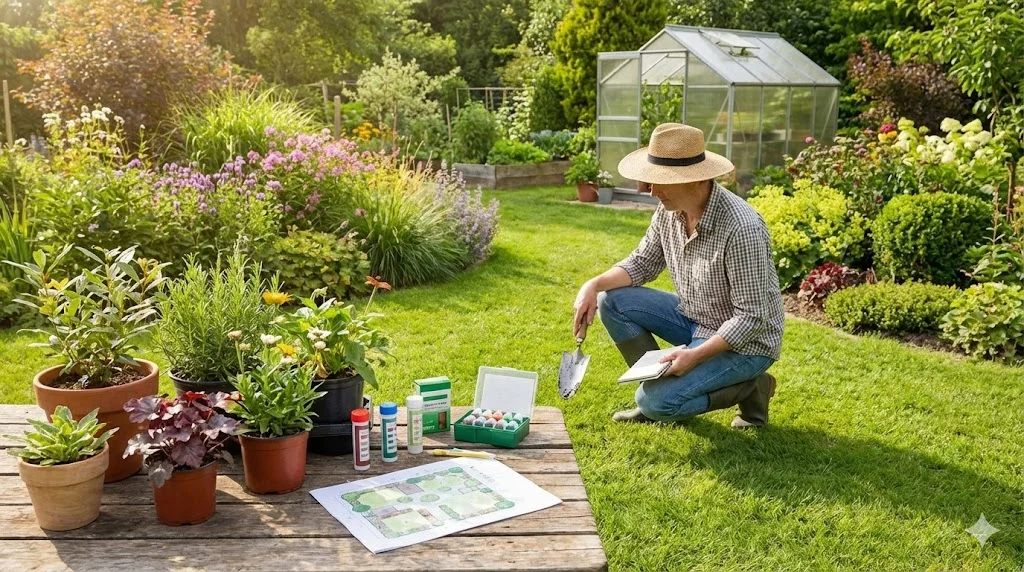
Walk through your garden at three different times on a clear day -- morning, midday, and late afternoon -- and note which areas are in sun and which are in shade. Record this on your garden plan using simple categories:
- Full sun: 6 or more hours of direct sunlight per day
- Partial sun / partial shade: 3-6 hours of direct sunlight
- Full shade: Less than 3 hours of direct sunlight
- Dappled shade: Sunlight filtered through a tree canopy
Remember that sun patterns change with the seasons. An area that gets full sun in midsummer may be heavily shaded in winter when the sun sits lower in the sky. Deciduous trees also change the equation -- a bed under a deciduous tree may get full spring sun before the canopy fills in.
The most common planting mistake is putting sun-loving plants in shade. They will survive for a year or two, growing leggy and sparse, but they will never look the way they do in the photographs on the label. Match the plant to the light, not your wishes.
Test Your Soil
Soil type determines which plants will thrive and which will struggle. You need to know three things about your soil:
Soil Texture
Pick up a handful of moist soil and squeeze it:
- Clay: Forms a sticky, smooth ball that holds its shape. Heavy, slow-draining, nutrient-rich.
- Sand: Falls apart immediately. Light, fast-draining, nutrient-poor.
- Loam: Holds together loosely but crumbles when poked. The ideal balance of drainage and moisture retention.
- Silt: Smooth and silky, holds together but feels less sticky than clay.
Soil pH
Buy a simple pH test kit and test several spots in your garden:
- Acidic (below 6.5): Suits rhododendrons, azaleas, camellias, blueberries, heathers
- Neutral (6.5-7.5): Suits the widest range of plants
- Alkaline (above 7.5): Suits lavender, clematis, dianthus, many Mediterranean plants
Trying to grow acid-loving plants in alkaline soil -- or vice versa -- is an expensive losing battle. Work with your soil, not against it.
Drainage
Dig a hole about 30 cm (12 inches) deep and fill it with water. If the water drains within an hour, your drainage is good. If it sits for several hours, you have poor drainage and need plants that tolerate wet feet -- or you need to improve drainage before planting.
Know Your Hardiness Zone
Hardiness zones tell you the minimum winter temperature a plant can survive. Every plant label or database entry includes a hardiness rating. Check which zone your garden falls in using your country's hardiness zone map:
- USDA zones (United States): Range from Zone 1 (extreme cold) to Zone 13 (tropical)
- RHS ratings (United Kingdom): H1 (tender, needs heated glass) to H7 (fully hardy)
Choose plants rated for your zone or colder. A plant rated for Zone 7 will survive in Zones 7 through 13 but will die in Zone 6. Microclimates within your garden -- a sheltered south-facing wall, a frost pocket in a hollow -- can shift the effective zone by one or two levels in either direction.
Plan for Year-Round Interest
A garden that peaks in July and looks bare from October to March has not been planted with succession in mind. The goal is to have something of interest in every month of the year.
A Succession Framework
| Season | Sources of Interest | Example Plants |
|---|---|---|
| Early spring | Bulbs, blossom, early perennials | Snowdrops, crocuses, hellebores, cherry blossom |
| Late spring | Tulips, fresh foliage, early roses | Tulips, alliums, wisteria, aquilegia |
| Early summer | Perennials, roses, annuals | Roses, geraniums, delphiniums, poppies |
| Late summer | Grasses, late perennials | Echinaceas, rudbeckias, dahlias, ornamental grasses |
| Autumn | Berries, foliage color, late flowers | Japanese maples, asters, sedums, cotoneaster berries |
| Winter | Bark, evergreen structure, winter flowers | Cornus stems, box hedging, winter jasmine, mahonia |
When selecting plants, check the flowering period for each one and make sure you have representatives in every season. A well-planned border should never be entirely dormant.
Choose the Right Plant for the Right Role
Plants serve different roles in a garden, and understanding these roles helps you make purposeful choices rather than impulse purchases.
Structure Plants
These are the evergreen backbone of your garden -- the plants that hold the design together when everything else has died back in winter. Examples: box (Buxus), yew (Taxus), holly (Ilex), Portuguese laurel (Prunus lusitanica), and ornamental grasses that hold their form through winter.
Place structure plants first. They define bed edges, create focal points, and provide the framework around which seasonal plants perform.
Filler Plants
Perennials, grasses, and bulbs that fill the middle and front of beds. These provide the color, texture, and seasonal change that make a border dynamic and interesting. Choose a mix of heights, textures, and flowering times.
Ground Cover
Low-growing plants that cover bare soil, suppress weeds, and knit the planting together. Examples: geranium macrorrhizum, ajuga, vinca, epimedium, and creeping thyme. Do not underestimate ground cover -- it reduces maintenance enormously and makes beds look mature much faster.
Specimen Plants
A single outstanding plant used as a focal point -- a beautiful tree, an architectural agave, a stunning magnolia. Specimen plants should be chosen for their year-round appeal, not just their flowering moment.
Use Plant Databases and Resources
Modern plant databases allow you to filter by every condition that matters: sun, soil, height, spread, hardiness zone, flowering season, and color. Use them. They save hours of browsing and prevent expensive mistakes.
When evaluating a plant, check:
- Mature size: Will it outgrow its space in five years?
- Growth rate: Fast growers fill gaps quickly but may need frequent pruning
- Maintenance needs: Does it need staking, deadheading, or division?
- Disease resistance: Some cultivars are bred for disease resistance -- choose these where available
- Wildlife value: Does it provide nectar, pollen, berries, or habitat?
You can also test plant placements in your garden design before buying anything, which helps you visualize mature sizes and spacing.
Spacing and Quantities
New gardeners almost always plant too far apart, leaving large gaps of bare soil that look sparse and invite weeds. Experienced gardeners plant closely and thin later if needed.
A useful rule of thumb: space plants at roughly two-thirds of their mature spread. A perennial with a 60 cm (24 inch) spread should be planted about 40 cm (16 inches) apart. This allows plants to knit together within one to two growing seasons.
For a border, calculate the area in square meters (or square feet) and divide by the spacing requirement to estimate the number of plants needed. Planting in odd-numbered groups -- three, five, or seven of the same plant -- creates natural-looking drifts rather than isolated dots.
Common Plant Selection Mistakes
- Buying one of everything: A garden with one of every plant looks like a collection, not a composition. Repeat key plants to create rhythm and cohesion.
- Ignoring mature size: That cute little shrub at the garden center may reach 3 meters (10 feet) in five years. Always check mature dimensions.
- Choosing for flower alone: A plant that flowers for two weeks and looks unremarkable for fifty weeks is a poor investment. Choose plants with good foliage, form, or bark as well as flowers.
- Forgetting winter: If you choose only summer-flowering plants, your garden will look bleak from November to March. Include evergreens and winter-interest plants.
- Fighting your conditions: Mediterranean plants in wet clay soil, woodland plants in baked sand -- these battles are not worth fighting. Embrace your conditions and your garden will reward you.
The best gardens are not the ones with the most expensive or exotic plants. They are the ones where every plant is well suited to its position, well combined with its neighbors, and contributes something in at least two seasons.
Getting Started with Plant Selection
Begin by creating a simple spreadsheet or list with these columns: plant name, role (structure / filler / ground cover / specimen), height, spread, sun requirement, soil preference, hardiness zone, and flowering season. As you research plants, fill in the list and look for gaps -- a season with no flowers, a bed with no structure, or a color palette that clashes.
For detailed guidance on arranging your selected plants into beautiful beds, see how to design a flower bed. And for the full design process from survey to planting, return to our complete beginner's guide to garden design.
Garden Design Team
Expert garden designers sharing tips, inspiration, and practical advice for creating beautiful outdoor spaces.
Explore professional garden design
Scapiera is a paid professional garden-design application. See plans for included capabilities and availability.
Join the waitlistRelated articles
Backyard Garden Design: Creating Your Outdoor Sanctuary
Design a backyard that works as an outdoor living space. Zoning for dining, relaxation, and play, with privacy screening and year-round planting.
Balcony Garden Design: Growing in Containers
Create a thriving balcony garden with smart container choices, wind-resistant plants, vertical systems, and self-watering solutions for high-rise growing.
Corner Lot Garden Design: Two-Sided Curb Appeal
Design a corner lot garden that impresses from both streets. Dual frontage planting, visibility sightlines, wraparound beds, and privacy from two directions.