
Prairie Garden Design: Grasses and Native Perennials
Design a stunning prairie garden with ornamental grasses and native perennials. Learn plant combinations, seasonal interest, and low-maintenance prairie techniques.
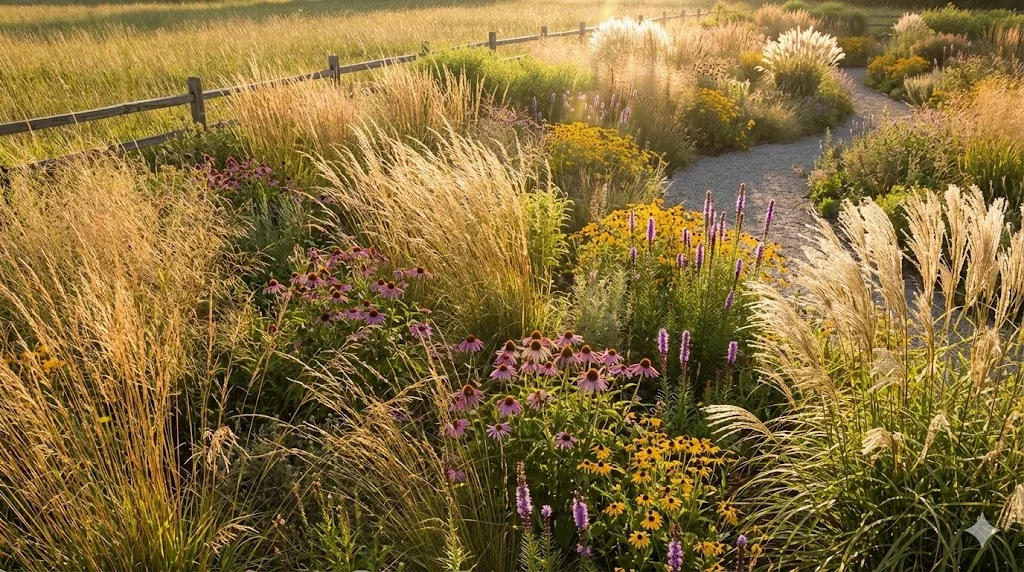
There is a moment in late summer when a well-planted prairie garden stops being a collection of individual plants and becomes something closer to a living landscape. Tall grasses catch the low evening light and turn to liquid gold, while coneflowers and blazing stars punctuate the scene with shots of purple and pink. The whole composition moves — every stem, every seedhead responding to the slightest breeze. It is a style of gardening that captures the immense, rolling beauty of the North American grasslands and distills it into a space you can walk through before breakfast.
Prairie garden design has gained devoted followers on both sides of the Atlantic over the past two decades, and for good reason. It delivers extraordinary seasonal interest with relatively modest upkeep, supports a remarkable diversity of pollinating insects, and — once established — shrugs off drought, poor soil, and neglect in ways that would defeat a traditional herbaceous border. Whether you garden on a quarter-acre suburban lot or a sprawling rural property, the prairie approach offers a way to create something genuinely beautiful that works with nature rather than against it.
Understanding Prairie Ecology
Before choosing a single plant, it helps to understand what makes a prairie tick. A true prairie is a grassland ecosystem dominated by grasses and herbaceous perennials, with few or no trees. In its native range across central North America, the prairie once covered over 170 million acres — a vast sea of vegetation shaped by three forces: fire, grazing, and drought.
Fire is the great rejuvenator. Periodic burns clear accumulated dead material, release nutrients back into the soil, suppress woody invaders (shrubs and tree seedlings), and stimulate fresh growth from deep root systems. Without fire, prairie gradually gives way to scrubland and eventually forest.
Grazing historically came from bison, elk, and pronghorn. These animals selectively ate the most vigorous grasses, opening gaps for slower-growing wildflowers and preventing any single species from monopolizing the space.
Drought — the summer dry spells common across the Great Plains — favored plants with deep, extensive root systems. Prairie grasses routinely send roots 2–3 meters (6–10 feet) into the ground, and some prairie plants reach depths of 5 meters (16 feet) or more. This root mass is one reason prairie plants are so resilient once established and so effective at building soil carbon.
In a garden setting, you cannot replicate all three forces exactly. But understanding them explains why prairie plants behave the way they do, and why certain maintenance practices — particularly cutting back hard once a year — produce the best results.
Prairie vs. Meadow: Knowing the Difference
The terms "prairie garden" and "meadow garden" are often used interchangeably, but they describe genuinely different plant communities, and confusing the two leads to planting mistakes.
A meadow is a grass-dominated community of relatively short, fine-leaved grasses mixed with wildflowers. European hay meadows, for example, rarely exceed 60 cm (2 feet) in height and are maintained by annual mowing (hay-cutting). The grasses are typically cool-season species that make most of their growth in spring and autumn. Wildflower meadows thrive on poor, lean soil and depend on regular mowing to prevent coarse grasses from smothering the flowers. For a deep dive into meadow techniques, our guide to wildflower garden design and meadow creation covers seed selection, soil preparation, and mowing regimes in detail.
A prairie, by contrast, is typically taller — ranging from 60 cm (2 feet) for short-grass prairie to over 2.5 meters (8 feet) for tall-grass prairie. The dominant grasses are warm-season species that grow most actively in the heat of summer. Prairie perennials are often large, deep-rooted plants with bold flower forms — coneflowers, compass plants, blazing stars — rather than the delicate wildflowers of a European meadow. Prairie is maintained by periodic burning or hard cutting, not by gentle hay-making.
In practical garden terms: if you want a low, flowery carpet reminiscent of an English countryside, you want a meadow. If you want tall, dramatic, grass-dominated planting with bold perennials and year-round structural presence, you want a prairie.
Essential Grasses for Prairie Garden Design
Grasses are the backbone of any prairie planting. They provide the matrix through which perennials emerge, and their foliage and seedheads deliver the movement, texture, and winter structure that define the style. Choose a mix of heights and habits for the most naturalistic effect.
Panicum virgatum (Switchgrass)
Switchgrass is the quintessential prairie grass. Native to North America, it forms upright clumps 1.2–1.8 m (4–6 feet) tall with airy flower panicles that emerge in midsummer and persist through winter. Cultivars such as 'Shenandoah' offer spectacular burgundy-red autumn color, while 'Northwind' provides a strongly vertical, blue-green column. Switchgrass tolerates a wide range of soils, including clay and occasionally wet ground, making it one of the most versatile choices for a prairie garden design.
Sporobolus heterolepis (Prairie Dropseed)
If switchgrass is the prairie's tall backbone, prairie dropseed is its fragrant heart. This fine-textured, mounding grass reaches only 60–90 cm (2–3 feet) in height, forming elegant fountain-shaped clumps. In autumn, the foliage turns rich apricot-orange, and the seed panicles release a distinctive scent often compared to warm cilantro or toasted grain. Prairie dropseed is exceptionally long-lived — individual plants can persist for decades — and thrives in lean, well-drained soil. It is perfect for the front of a prairie planting or as a flowing ground-level matrix.
Miscanthus sinensis (Silver Grass)
While not a native prairie plant, Miscanthus has become indispensable in European and British interpretations of the prairie style. Cultivars like 'Malepartus' (early-flowering, coppery plumes), 'Gracillimus' (fine-leaved, arching form), and 'Morning Light' (variegated, luminous) provide height, movement, and spectacular winter silhouettes. Miscanthus thrives in moist, moderately fertile soil and pairs superbly with late-flowering perennials. When planning your planting layout, consider placing Miscanthus cultivars as focal anchors within larger drifts of lower grasses.
Molinia caerulea (Purple Moor Grass)
Molinia is a European native and an outstanding choice for adapting the prairie style to cooler, damper climates. The subspecies arundinacea (tall moor grass) can reach 2 m (6.5 feet), with graceful, transparent flower stems that create a veil-like effect when backlit. 'Transparent' and 'Windspiel' are deservedly popular cultivars. Molinia is deciduous — its foliage and stems detach cleanly in late autumn, leaving almost no debris. This self-cleaning habit makes it exceptionally low-maintenance.
Stipa gigantea (Giant Feather Grass)
Stipa gigantea is one of the most visually dramatic of all grasses. From a modest evergreen base rosette, it sends up 2 m (6.5 feet) flower stems in early summer, carrying golden oat-like spikelets that shimmer in any breeze. It functions beautifully as a transparent screen — you look through the flower stems rather than at a solid mass. Native to the Iberian Peninsula, it is well-suited to dry, sunny positions and brings a distinctly Mediterranean warmth to prairie-style plantings.
Perennial Partners: Color Through the Seasons
A prairie without perennials is just a hayfield. The wildflowers and forbs provide the color, the pollinator resources, and much of the visual excitement. In prairie garden design, perennials are planted in sweeping drifts — not dotted individually — to mirror the way they naturally colonize the landscape.
Echinacea purpurea (Purple Coneflower)
The iconic prairie perennial. Bold, daisy-like flowers with raised central cones appear from midsummer through early autumn, attracting bees, butterflies, and goldfinches (who feast on the seeds). Plants reach 60–120 cm (2–4 feet) and are reliably hardy across most temperate regions. 'Magnus' and 'White Swan' are proven performers. The spent cones persist through winter, providing architectural interest and food for seed-eating birds.
Rudbeckia fulgida (Black-Eyed Susan)
Rudbeckia delivers the warm yellows and golds that define late-summer prairie scenes. The variety sullivantii 'Goldsturm' is one of the most reliable garden perennials of any style — compact, free-flowering, and long-lived. Plants reach 60–75 cm (24–30 inches) and spread steadily to form dense patches. They are outstanding in drifts alongside purple coneflowers, where the yellow-and-purple color combination echoes countless wild prairie communities.
Liatris spicata (Blazing Star)
Liatris is a natural prairie classic with an unusual trick: its dense flower spikes open from the top downward, creating a striking candle-flame effect in rosy purple. Growing 60–120 cm (2–4 feet) tall, blazing star is a magnet for butterflies — especially monarchs — and its vertical form contrasts beautifully with the rounded heads of coneflowers and the horizontal layers of grasses. It grows from a corm and prefers well-drained soil.
Monarda fistulosa (Wild Bergamot)
Wild bergamot adds a soft lavender-pink haze to the midsummer prairie, and its aromatic foliage carries a pleasant oregano-like scent. Plants reach 60–120 cm (2–4 feet) and spread by runners to form generous patches. It is one of the most important nectar plants for native bees and is also beloved by hummingbird moths. The closely related Monarda didyma (bee balm) offers scarlet flowers but demands moister conditions.
Aster (Symphyotrichum) Species
No prairie planting is complete without asters to close the season. New England aster (Symphyotrichum novae-angliae) produces dense clusters of violet-purple, pink, or white daisies from September well into October, while aromatic aster (S. oblongifolium) forms low mounds covered in lavender-blue flowers. Asters provide critical late-season nectar when little else is in bloom and combine exquisitely with the golden autumn foliage of grasses.
Planting in Drifts: The Prairie Layout
The single most important design principle in prairie garden design is planting in drifts rather than in traditional border arrangements. In nature, prairie plants form interlocking, irregularly shaped patches — some species in long, narrow ribbons, others in broad pools. Replicating this pattern is what gives a prairie planting its naturalistic character.
Scale your drifts to your space. In a large garden, individual drifts might contain 20–50 plants of a single species. In a smaller garden, drifts of 5–9 plants (always odd numbers for a natural look) create the same effect at a more intimate scale. The key is repetition: the same species should appear in several drifts throughout the planting, not in a single isolated clump.
Layer heights deliberately. Place taller grasses (Panicum, Miscanthus, Molinia) toward the center or back of the planting, with lower grasses (prairie dropseed, Stipa tenuissima) toward the edges. Thread perennials through the grasses at varying heights so that color appears at multiple levels. This creates the depth and complexity that makes a prairie planting so visually rich.
Interplant, don't segregate. Unlike a traditional border where grasses and perennials occupy separate zones, a prairie planting weaves them together. A drift of Echinacea should emerge through a haze of switchgrass. Liatris spikes should punctuate a mass of prairie dropseed. This intermingling is what distinguishes prairie style from other naturalistic approaches.
Use a garden design tool to experiment with drift shapes, spacing, and height layering before committing plants to the ground — it is far easier to rearrange drifts on screen than to dig up misplaced grasses.
Seasonal Interest: From Summer Blaze to Winter Bones
One of the greatest strengths of prairie garden design is that it delivers twelve months of visual interest without the need for seasonal replanting.
Spring (March–May). The prairie wakes slowly. Fresh green shoots emerge from the base of last year's cut-back grasses, and early perennials like prairie smoke (Geum triflorum) and blue false indigo (Baptisia australis) provide flower color while the grasses are still low. This is the season of promise and emerging texture.
Summer (June–August). The full drama unfolds. Grasses reach their mature height, and the perennial sequence begins: Echinacea and Rudbeckia in bold swathes of purple and gold, Liatris spikes shooting upward, Monarda filling the air with scent and color. This is the prairie at its most photogenic — tall, lush, buzzing with life.
Autumn (September–November). Many gardeners consider this the prairie's finest hour. Asters provide a final rush of flower color, but the real magic is in the grasses. Panicum turns wine-red, prairie dropseed glows apricot, Miscanthus unfurls silky plumes, and Molinia becomes a column of liquid amber. The entire planting shifts into a warm palette of gold, bronze, copper, and russet that no other garden style can match.
Winter (December–February). This is where the prairie earns its keep. While most gardens retreat into bare soil and dormancy, a prairie planting stands tall. Frosted seedheads of Echinacea and Rudbeckia, the bleached straw of Miscanthus plumes, the fine skeletal structure of Molinia stems — all catch the low winter light and create scenes of extraordinary beauty, especially with a dusting of frost or snow. Leave everything standing until late winter; cutting back too early robs the garden of its most atmospheric season and removes food and shelter for overwintering wildlife.
Maintenance: Keeping the Prairie Healthy
Prairie gardens are genuinely low-maintenance compared to traditional borders, but they are not no-maintenance. The key tasks are straightforward.
Annual Cut-Back
Once a year, in late winter (February or early March in most temperate climates), the entire planting should be cut to 10–15 cm (4–6 inches) above ground level. This removes the previous year's growth, allows light to reach the emerging new shoots, and prevents the accumulation of thatch that would smother smaller plants. On small plantings, hand shears or a powered hedge trimmer will do the job. On larger areas, a string trimmer or even a brush cutter is more practical. Compost the cut material or, if possible, leave it to dry and remove it after a week.
Controlled Burning
In North America, many prairie gardeners and restoration ecologists use controlled fire instead of cutting. A quick, hot burn in late winter accomplishes the same goals as cutting — removing dead material and stimulating regrowth — but also kills weed seeds near the surface, returns ash nutrients to the soil, and triggers certain fire-adapted species (like blazing star and prairie dropseed) to flower more abundantly.
Burning is not an option for every gardener. It requires appropriate permits (check local regulations), adequate firebreaks, calm weather, and ideally some experience. In suburban and urban settings, cutting back is the safer and more practical alternative. In rural or large-scale plantings, however, an annual or biennial burn is the single most effective maintenance technique for long-term prairie health.
Weed Management
In the first two to three years after planting, while the prairie plants are establishing their deep root systems, weed competition can be fierce. Annual weeds (chickweed, fat hen, annual meadow grass) will germinate in any bare ground. Hand-pulling or spot-hoeing during the first few growing seasons is essential. Once the prairie canopy closes — typically by year three — the dense root mat and tall, light-intercepting foliage of established grasses will suppress most weeds naturally.
Perennial weeds (couch grass, bindweed, creeping thistle) are a more serious threat and should be removed as completely as possible before planting. If they appear later, hand-digging is the safest option in an established prairie, as broadleaf herbicides will damage the perennials you want to keep.
Dividing and Thinning
After five to seven years, some prairie perennials (particularly Monarda and Rudbeckia) may form congested clumps that flower less freely. Lift and divide these in early spring, replanting vigorous outer sections and composting exhausted centers. Grasses rarely need dividing unless they develop dead centers — Miscanthus is the most likely candidate.
Adapting Prairie Style to European and UK Gardens
The prairie aesthetic originated in North America, but it adapts beautifully to European and British conditions with a few adjustments.
Climate considerations. Much of Western Europe and the UK receives more rainfall and less summer heat than the central United States. This means warm-season grasses like Panicum and Sporobolus may be slower to establish and slightly shorter in height. Compensate by including more cool-season grasses (Molinia, Stipa, Deschampsia cespitosa) that thrive in maritime climates. The Dutch and German "New Perennial" movement — championed by Piet Oudolf, Cassian Schmidt, and others — has demonstrated that prairie-style planting works superbly across Northern Europe, particularly when adapted to local rainfall and soil conditions.
Soil and drainage. Many prairie plants evolved on deep, well-drained loam. If your garden sits on heavy clay, improve drainage by adding grit to the planting holes or build slightly raised beds. Alternatively, choose species that tolerate heavier soils: Panicum virgatum, Molinia, Rudbeckia, and Monarda all cope well with clay. If you are working with a dry, sandy site, lean into it — prairie dropseed, Echinacea, Liatris, and Stipa all excel in lean, well-drained ground.
Native plant ethics. In Europe, there is understandable interest in planting native species wherever possible. A pure North American prairie would be ecologically foreign in a British or Continental European garden. The solution is to blend: use native European grasses (Molinia, Deschampsia, Stipa) alongside carefully chosen North American perennials (Echinacea, Rudbeckia, Aster) that have proven pollinator value in European trials. This approach gives you the prairie aesthetic while maintaining ecological sensitivity. For more on building an ecologically grounded garden with plants suited to your local ecosystem, see our guide to native plant garden design.
Scale. Prairie gardens do not require vast acreage. Even a strip 2 meters (6.5 feet) wide along a sunny fence can deliver the full prairie experience if planted with the right combination of grasses and perennials. In small gardens, avoid the tallest grasses (Miscanthus sinensis cultivars above 2 m) and focus on mid-height species — Panicum 'Northwind', Molinia 'Transparent', prairie dropseed — that provide the movement and texture of prairie without overwhelming the space.
Getting Started: A Simple Prairie Planting Recipe
For gardeners new to prairie garden design, here is a straightforward combination for a sunny, well-drained site of roughly 10 square meters (about 100 square feet):
- 5 Panicum virgatum 'Shenandoah' — tall structure, autumn color
- 7 Sporobolus heterolepis — low matrix, fragrance, fine texture
- 7 Echinacea purpurea 'Magnus' — midsummer purple
- 5 Rudbeckia fulgida 'Goldsturm' — late-summer gold
- 5 Liatris spicata — vertical accent, butterfly magnet
- 3 Molinia caerulea 'Transparent' — airy height, veil effect
- 5 Aster (Symphyotrichum) oblongifolium 'October Skies' — autumn finale
Plant in interlocking drifts, spacing grasses at 45–60 cm (18–24 inches) apart and perennials at 30–45 cm (12–18 inches). Water regularly through the first growing season, then let the plants fend for themselves. By the second summer, the planting will begin to knit together. By the third, it will look as though it has been there for decades.
Prairie garden design rewards patience. The first year, the plants are settling in, sending roots deep into the ground rather than producing impressive top growth. The second year, the structure emerges. From the third year onward, you have a garden that improves with every passing season — a living community of grasses and native prairie plants that asks for remarkably little in return for the beauty it provides.
For more inspiration across the full range of naturalistic and structured garden approaches, explore our complete guide to garden design styles, which places the prairie approach in context alongside cottage, formal, Mediterranean, and many other traditions.
Garden Design Team
Expert garden designers sharing tips, inspiration, and practical advice for creating beautiful outdoor spaces.
Explore professional garden design
Scapiera is a paid professional garden-design application. See plans for included capabilities and availability.
Join the waitlistRelated articles
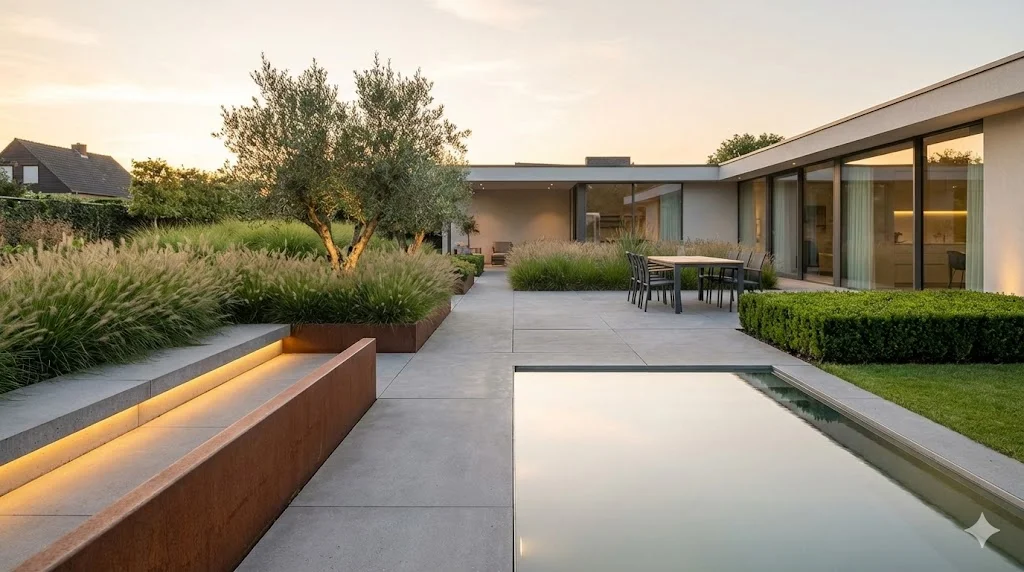
Garden Design Styles: The Complete Guide
Explore every major garden design style from cottage to Japanese, modern to Mediterranean. Find the perfect style for your space, climate, and taste.
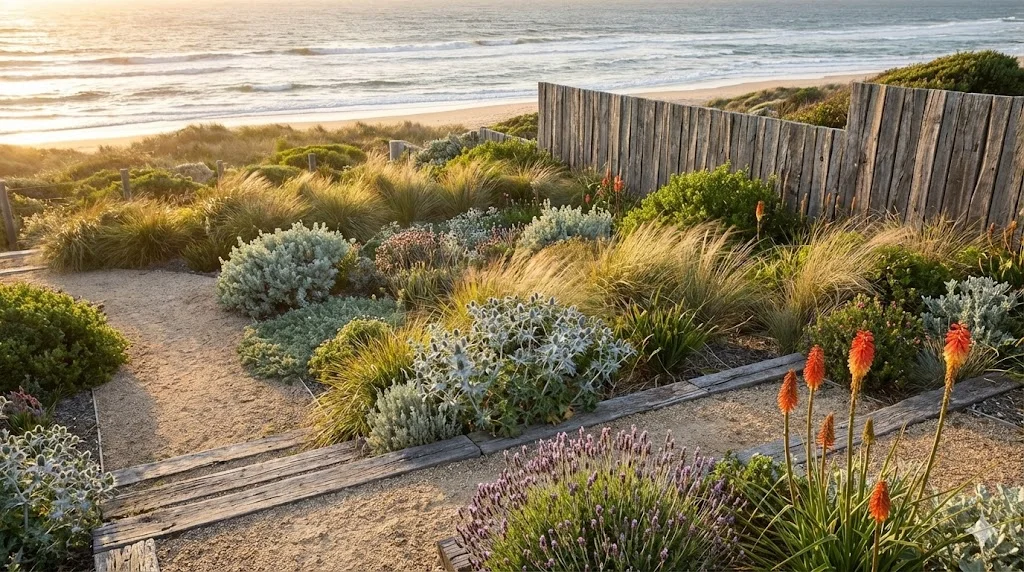
Coastal Garden Design: Salt-Tolerant Beauty
Design a beautiful coastal garden that thrives in salt spray, wind, and sandy soil. Discover the best seaside garden plants and design techniques for exposed sites.
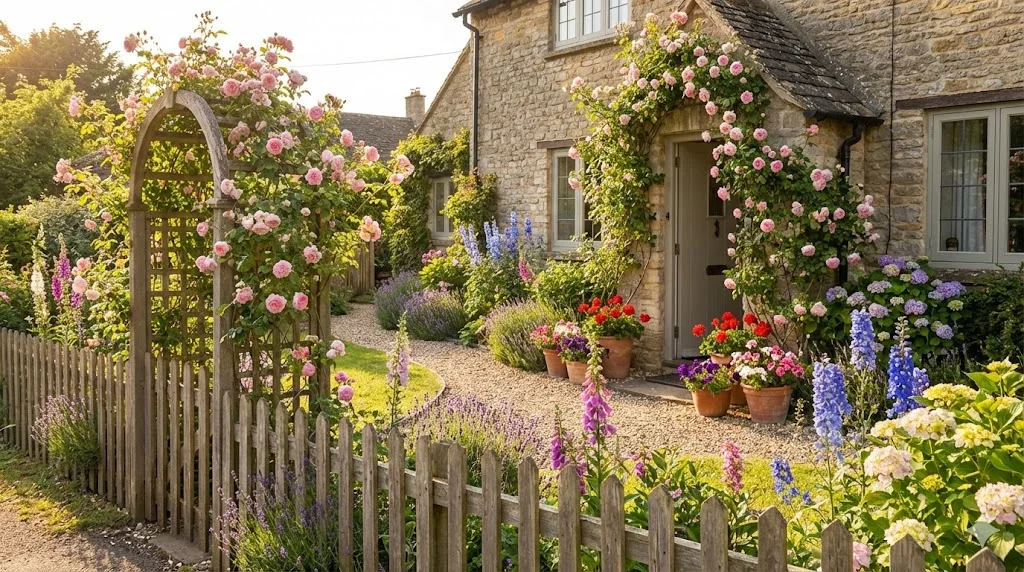
Cottage-Style Front Garden: Welcoming and Colorful
Transform your front garden into a welcoming cottage paradise with climbing roses, flower-lined paths, and seasonal color. Design tips for maximum curb appeal.