
How to Design a Garden for Privacy
Discover how to design a garden for privacy using screening plants, hedges, fences, raised beds, and layered planting strategies for peaceful seclusion.
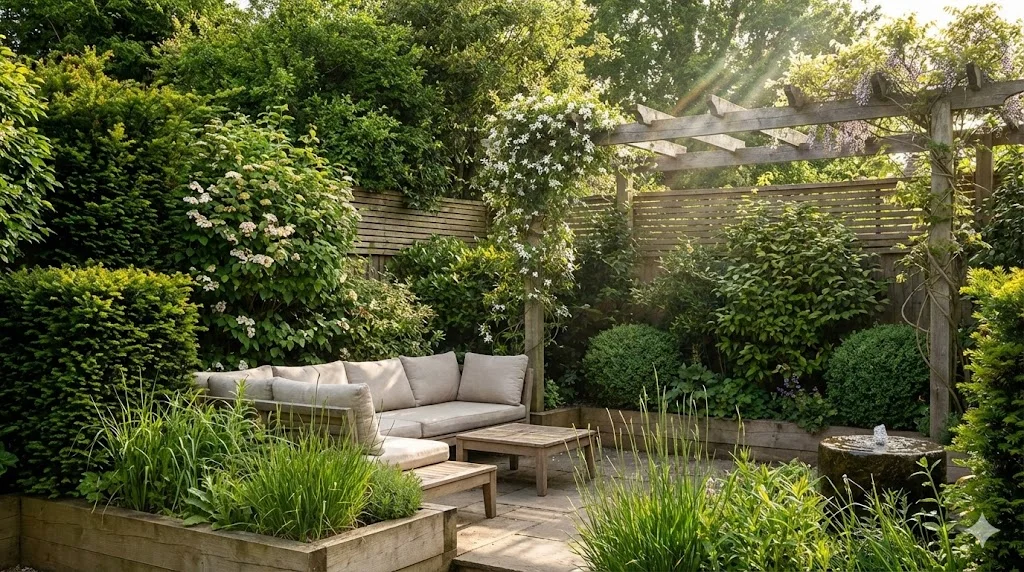
How to Design a Garden for Privacy
Privacy transforms a garden from an outdoor space into a sanctuary. Without it, you feel watched, self-conscious, and unable to relax. With it, even a small urban garden becomes a retreat where you can read, eat, and unwind without the awareness of neighbors or passers-by.
The challenge is creating privacy without making your garden feel like a fortress. A solid 2-meter (6-foot) fence on all sides provides privacy but also blocks light, traps wind, and makes a small space feel claustrophobic. The best privacy design uses a combination of strategies -- fences, hedges, planting, structures, and clever level changes -- layered to create seclusion while keeping the garden open, light, and beautiful. This guide covers every approach. For the full garden design process, see our beginner's guide to designing a garden from scratch.
Assess Your Privacy Needs
Before spending money on screening, identify exactly what you need privacy from. Walk around your garden and sit in every potential seating position. Look up, look sideways, and note:
- Which neighbors can see in? From which windows and which angles?
- Can passers-by see into the garden? From the street, a public path, or a higher road?
- Is the issue overlooking from above? Upper-story windows and balconies are the hardest to screen.
- Is noise a factor? Traffic noise, neighbor conversations, or barking dogs may need softening.
- Is the problem seasonal? A deciduous tree screens beautifully in summer but is bare in winter when you might not use the garden.
Map these issues on your garden plan. You may find that you only need privacy in one corner -- the main seating area -- rather than around the entire boundary.
Do not screen more than you need to. Over-screening creates a claustrophobic box that traps wind and blocks light. Target privacy where you need it most and leave the rest of the garden open.
Hedges: The Best All-Round Screen
A hedge is the finest privacy screen in any garden. Unlike a fence, a hedge filters wind instead of creating turbulence. It absorbs sound, supports wildlife, and adds beauty in its own right. The downside is time -- a hedge takes two to four years to reach full screening height.
Best Hedging Plants for Privacy
- Yew (Taxus baccata): Dense, dark, elegant. Grows 20-30 cm (8-12 inches) per year. The classic formal hedge. Evergreen.
- Hornbeam (Carpinus betulus): Deciduous but holds brown leaves through winter, providing year-round screening. Tolerates heavy soil.
- Laurel (Prunus laurocerasus): Big, bold, glossy leaves. Fast-growing (40-60 cm / 16-24 inches per year). Provides thick screening quickly.
- Holly (Ilex aquifolium): Prickly, dense, and beautiful. Slower growing but virtually impenetrable. Evergreen.
- Griselinia littoralis: Apple-green glossy leaves. Excellent for coastal and mild areas. Evergreen.
- Photinia 'Red Robin': Bright red new growth in spring. Fast-growing and dense. Evergreen.
Hedge Planting Tips
- Plant in a single row for most species, spacing 3-5 plants per meter (1-2 per foot) depending on species
- For instant thickness, plant a double staggered row
- Water well during the first two summers
- Trim twice a year (once in late spring, once in late summer) for most species
- Yew tolerates hard pruning if it gets too wide; laurel responds well to renovation pruning
Fences and Screens
For immediate privacy, fences are the quickest solution. They provide screening from day one and can be designed to complement your garden style.
Fence Types for Privacy
- Close-board: The standard privacy fence. Solid vertical boards with no gaps. Effective but can feel severe.
- Hit-and-miss: Boards alternated on each side of the rail, creating partial transparency. Provides privacy from direct view while allowing air and light through.
- Slatted screens: Horizontal or vertical slats with narrow gaps. Contemporary feel. Good for filtering views without blocking light.
- Woven panels: Willow, hazel, or bamboo panels. Natural feel. Good for cottage and informal gardens.
- Metal and glass: Frosted glass panels, perforated metal screens, or corten steel. Modern, architectural, and space-saving.
Height Regulations
Most areas have regulations limiting boundary fence height -- typically 2 meters (6.5 feet) at the rear and 1 meter (3 feet) at the front. Trellis added on top of a fence sometimes falls outside these limits, but check your local regulations. For a comprehensive guide, see how to design a garden fence.
Layered Planting for Depth
The most effective privacy comes from layers of planting at different heights, creating depth rather than a single flat barrier. A layered screen also looks more natural and provides better wildlife habitat.
A Three-Layer Screening Model
Canopy layer (3-5 meters / 10-16 feet): Small trees with dense canopies -- silver birch (multi-stem), amelanchier, crab apple, Portuguese laurel (tree form). These block high-angle views from upper windows.
Shrub layer (1.5-3 meters / 5-10 feet): Evergreen and semi-evergreen shrubs that provide the main body of screening. Mix species for interest: Viburnum tinus, Elaeagnus x ebbingei, Osmanthus, Choisya.
Ground layer (under 1.5 meters / 5 feet): Low shrubs, tall perennials, and grasses that fill the base and prevent views through legs of taller plants. Hydrangea, Sarcococca, large ferns, tall grasses.
This layered approach creates a living wall that screens from all angles while looking like a beautiful planting bed rather than a barrier.
Raised Beds and Level Changes
Raising the planting level near a boundary effectively adds height to your screen without tall fences. A raised bed 60 cm (2 feet) high with a 1.2-meter (4-foot) hedge on top creates a screen equivalent to a 1.8-meter (6-foot) fence -- but one covered in greenery.
Raised beds are also useful alongside patios. A raised planter between the seating area and the neighbor's fence, filled with tall grasses or bamboo, provides immediate screening exactly where you need it.
Structures for Privacy
Pergolas and Covered Seating
A pergola over your seating area provides overhead screening from upper-story windows. Clothe it with climbing plants -- jasmine, wisteria, climbing roses, grape vines -- and you create a green ceiling that blocks views from above while feeling open at the sides.
Garden Rooms
Creating a distinct garden room -- enclosed on three sides by planting or screens with an open front facing away from overlooking -- provides complete privacy within a contained space. The rest of the garden can be more open. For more on this approach, see how to design an outdoor living space.
Noise Reduction
Privacy is not only visual -- noise intrusion can be just as disruptive. While no garden planting blocks noise completely, several strategies reduce it:
- Water features: The sound of running water masks traffic and neighbor noise. Even a small bubbling stone feature makes a difference. See how to design a water feature.
- Dense planting: Thick, multi-layered planting absorbs some sound, especially high-frequency noise like voices.
- Earth mounding: A raised earth berm planted with shrubs is one of the most effective noise barriers in a garden.
- Solid walls: Brick or stone walls reflect sound more effectively than fences or planting, but they are expensive and reduce light.
Quick Fixes While Long-Term Screens Grow
Hedges and trees take time. While they establish, use these interim solutions:
- Bamboo screens: Roll-up bamboo screening attached to existing fences provides immediate visual screening
- Fast-growing climbers on trellis: Clematis montana, Russian vine, or hop can cover a trellis in one or two growing seasons
- Container planting: Tall grasses, bamboo, or standard trees in large pots placed strategically where needed
- Sail shades: Triangular shade sails angled to block overhead views from upper windows
You can plan your privacy screening in your garden layout to see how different screening heights and positions will work before committing to planting or building.
Getting Started
Walk your garden and identify the one spot where privacy matters most -- your main seating area. Focus your first efforts there. Install a fence or screen for immediate privacy, plant a hedge or layered screen in front for long-term beauty, and add a water feature for sound masking. Once this core area feels private, extend the screening to other parts of the garden as time and budget allow.
For the complete garden design process, return to our beginner's guide to designing a garden from scratch.
Garden Design Team
Expert garden designers sharing tips, inspiration, and practical advice for creating beautiful outdoor spaces.
Explore professional garden design
Scapiera is a paid professional garden-design application. See plans for included capabilities and availability.
Join the waitlistRelated articles
Backyard Garden Design: Creating Your Outdoor Sanctuary
Design a backyard that works as an outdoor living space. Zoning for dining, relaxation, and play, with privacy screening and year-round planting.
Balcony Garden Design: Growing in Containers
Create a thriving balcony garden with smart container choices, wind-resistant plants, vertical systems, and self-watering solutions for high-rise growing.
Corner Lot Garden Design: Two-Sided Curb Appeal
Design a corner lot garden that impresses from both streets. Dual frontage planting, visibility sightlines, wraparound beds, and privacy from two directions.