
Garden Design for Any Space: Complete Guide
Master garden design for every space type — small, large, narrow, sloped, front, back, courtyard, balcony, and more. Find the right approach for your plot.
Garden Design for Any Space: Complete Guide
Every garden begins with a plot of ground -- or a balcony, a rooftop, a narrow passage between buildings, or a steep hillside that seems impossible to plant. The shape, size, and orientation of your outdoor space is the single biggest factor in determining what kind of garden you can create. A design that works beautifully in a wide, flat backyard will fail in a courtyard hemmed in by walls.
Yet gardeners often start with a style -- cottage, modern, Mediterranean -- rather than with the space itself. That is doing things backwards. The most successful gardens respond to the unique constraints and opportunities of the site. This guide covers fourteen distinct types of garden space, from compact balconies to sprawling wraparound plots. For each one, you will find the key challenges, the design strategies that work, and a link to a detailed guide.
If you are also exploring which garden design style suits you, our complete guide to garden design styles is the perfect companion to this guide. Style and space work together: understanding both will give you the strongest foundation for any garden project.
Which Space Do You Have?
Before diving in, identify which type of space -- or combination of spaces -- applies to your situation. Most gardens fall into at least one of these categories, and many fall into two or three at once. A terraced house might have a narrow front yard, a small back garden, and a neglected side passage. Combining advice from two or three guides gives you the most complete picture for your unique space.
Size-based -- Is your garden small, large, or somewhere in between? Size determines your planting density, structural choices, and how many distinct zones you can create.
Terrain -- Is your garden flat, gently sloping, or steeply graded? Slopes introduce drainage, access, and structural challenges that flat gardens never face.
Location on your property -- Is this a front garden, a backyard, or a forgotten side passage? Each position carries different priorities around privacy, kerb appeal, and daily use.
Enclosed spaces -- Do you have a courtyard, balcony, or rooftop? Enclosed and elevated spaces have their own microclimate, weight, and access considerations.
Unusual shapes -- Is your plot L-shaped, on a corner, or wrapping around your house? Non-rectangular spaces need creative layout strategies to avoid dead zones and wasted potential.
Size-Based Design
The dimensions of your garden set the fundamental rules for everything else. A small garden demands discipline and clever spatial tricks. A large garden needs structure to avoid feeling shapeless. A narrow garden requires strategies to create width where there is none.
Small Gardens
A small garden is not a limitation -- it is an invitation to design with precision. Every plant, path, and material choice matters because there is nowhere to hide mistakes. The most successful small gardens feel significantly larger than they are, and that illusion comes from deliberate design: layering, vertical planting, and careful control of sight lines. A single well-placed tree underplanted with shade-loving perennials can create the impression of a garden three times its actual size. Mirrors, light-coloured walls, and diagonal paths all contribute to the sense of expansion.
Small gardens also benefit from restraint in the plant palette. Rather than cramming in one of everything, choose three or four species and repeat them. Repetition creates rhythm and unity -- the opposite of the cluttered feeling that plagues many compact plots. When you map out your garden's dimensions before committing to a design, you can test these spatial tricks and see which ones genuinely work for your plot.
Best for: Urban terraces, starter homes, anyone who wants maximum impact from minimum space.
Read the full Small Garden Design Guide -->
Large Gardens
A large garden offers freedom, but freedom without structure leads to chaos. The biggest challenge is not filling the space -- it is organising it so each area has purpose and the whole feels coherent. Without clear zoning, a large garden becomes a vague expanse of lawn with isolated shrubs dotted about like afterthoughts.
The solution is to think of your garden as a series of connected rooms. Each room serves a different function -- entertaining, growing food, quiet retreat, children's play -- and the transitions between them provide structure. Hedges, changes in level, and shifts in planting style create boundaries without walls. Anchor points like specimen trees, water features, and seating areas give the eye something to rest on and draw you through the space.
Best for: Suburban and rural properties, families who want multiple garden zones, anyone who finds their large garden feels empty.
Read the full Large Garden Design Guide -->
Narrow Gardens
Narrow gardens are among the most common spaces in urban settings. The typical long, thin plot behind a terraced house can feel like a corridor. The temptation is to lay a path straight down the middle and plant borders on each side, but this only emphasises the narrowness.
The fundamental principle is to break the sight line. Staggered planting, diagonal paths, and strategically placed screening interrupt the tunnel effect. Width can also be created through strong horizontal lines: a wide timber bench, a low retaining wall, or a band of different paving. These elements pull the eye sideways and counteract the dominant length.
Best for: Terraced house gardens, side-return extensions, any plot where the length significantly exceeds the width.
Read the full Narrow Garden Design Guide -->
Terrain
The topography of your site is not something you can change cheaply or easily. A sloped garden presents genuine engineering challenges -- but it also offers dramatic possibilities that flat gardens can never match.
Sloped Gardens
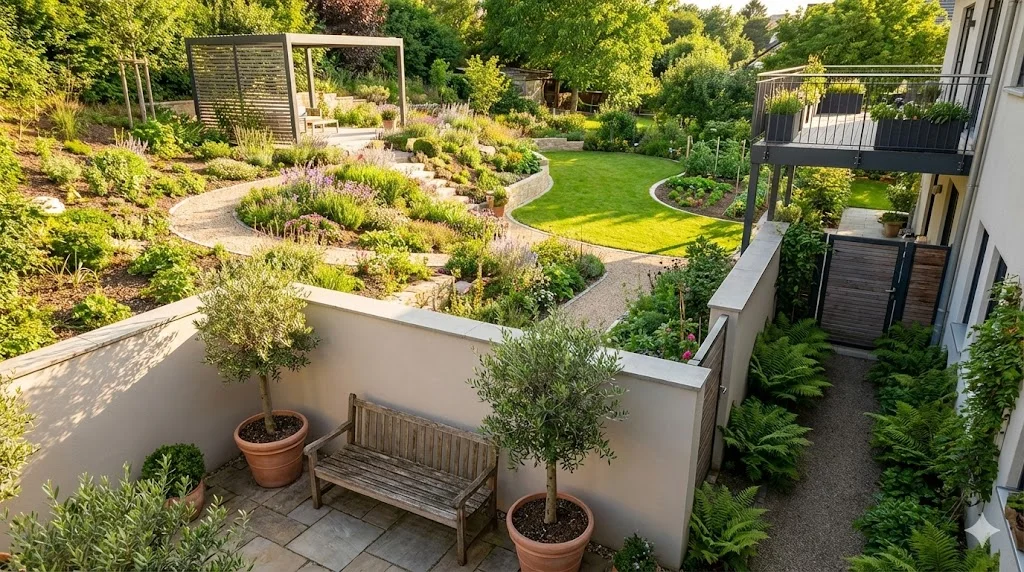
A slope is a garden waiting to be sculpted. While flat plots require you to manufacture interest, a sloped garden has built-in drama: views from the top, intimate enclosure at the bottom, and the play of light across terraced levels. The challenge is harnessing that drama while solving practical problems of drainage, access, and soil erosion.
Terracing is the classic solution. A series of level platforms connected by steps transforms an unworkable hillside into usable garden rooms. Each terrace can have its own character -- dining near the house, a productive garden on a sunny mid-level, a wild meadow at the lowest point. For gentler slopes, planted ground-cover species and gravel paths that zigzag up the gradient create a naturalistic garden that works with the land.
Best for: Hillside properties, gardens with significant level changes, anyone who wants a garden with natural drama and distinct zones.
Read the full Sloped Garden Design Guide -->
Location-Based Design
Where your garden sits in relation to your house and the street determines how you use it, who sees it, and what it needs to achieve. A front garden is a public face; a backyard is a private retreat; a side yard is an overlooked opportunity.
Front Yards
Your front garden is the first thing visitors see and the last thing you see before leaving home. Yet front gardens are often the most neglected spaces -- paved over for parking, left as tired lawn, or planted with whatever the previous owners chose a decade ago.
Good front garden design balances kerb appeal with practicality: a clear path to the door, space for bins and bicycles, and planting that looks attractive year-round. Symmetrical planting flanking the front door, a well-chosen small tree, and evergreen structure create a sense of care and intention.
Best for: Anyone wanting to improve their home's first impression, properties where the front garden has been neglected or paved over.
Read the full Front Yard Design Guide -->
Backyards
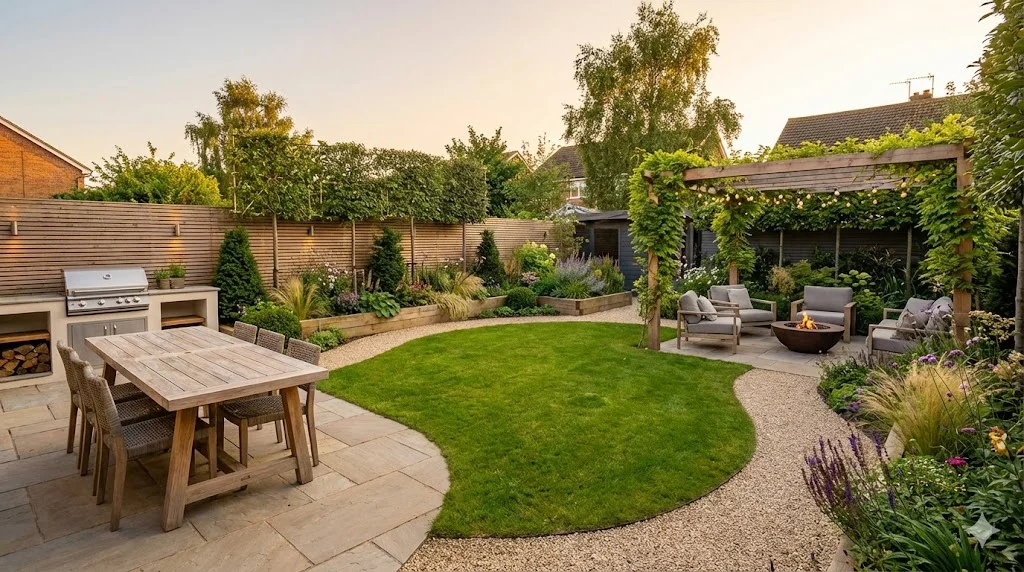
The backyard is where most garden living happens -- eating outdoors, children's play, growing vegetables, unwinding after work. It is the most personal part of most gardens and deserves design attention proportional to its importance.
The key is understanding your priorities. A family with young children needs safe play space and clear sight lines from the kitchen. An enthusiastic cook wants raised beds within easy reach. Even in a modest backyard, defining distinct areas -- dining near the house, planting in the middle, a quiet corner at the far end -- creates richness that a single open space cannot match.
Best for: Everyone -- the backyard is the heart of most gardens and benefits enormously from thoughtful design.
Read the full Backyard Design Guide -->
Side Yards
The side yard -- that narrow strip between your house and the boundary fence -- is the most underused space in most gardens. It tends to become a dumping ground for wheelie bins and old pots. But with imagination, a side yard can become a beautiful transition space or even a secret garden.
Shade-tolerant ferns, hostas, and climbing hydrangeas thrive in these typically narrow, shaded conditions. When you visualise the planting along your side passage before buying a single plant, you avoid choosing species that outgrow the space within a year. Consider practical functions too: a composting area or bin bay screened by trellis.
Best for: Terraced and semi-detached houses, anyone with an unused or unattractive side passage connecting front and back gardens.
Read the full Side Yard Design Guide -->
Enclosed Spaces
Some garden spaces are defined by their enclosure -- walls, railings, parapets, or the sheer fact of being elevated above ground. Courtyards, balconies, and rooftops each have a distinct set of constraints and opportunities that require specialist design thinking.
Courtyards
A courtyard garden is an outdoor room in the truest sense. Enclosed on three or four sides by walls, it has a quality of shelter and intimacy that open gardens cannot match. Light bounces off walls, creates sharp shadows, and changes character through the day. Sound is contained, making water features especially effective.
Every surface matters: floor, walls, and the sky overhead. Attractive paving, wall-mounted planters, climbing plants, and a carefully chosen small tree can transform even the smallest courtyard. Because courtyards tend to be overlooked from upper windows, consider the overhead view too -- a paving pattern or container arrangement that reads well from above adds daily pleasure.
Best for: Urban homes, properties with enclosed outdoor areas, anyone who wants a garden that feels like an outdoor room.
Read the full Courtyard Garden Design Guide -->
Balconies
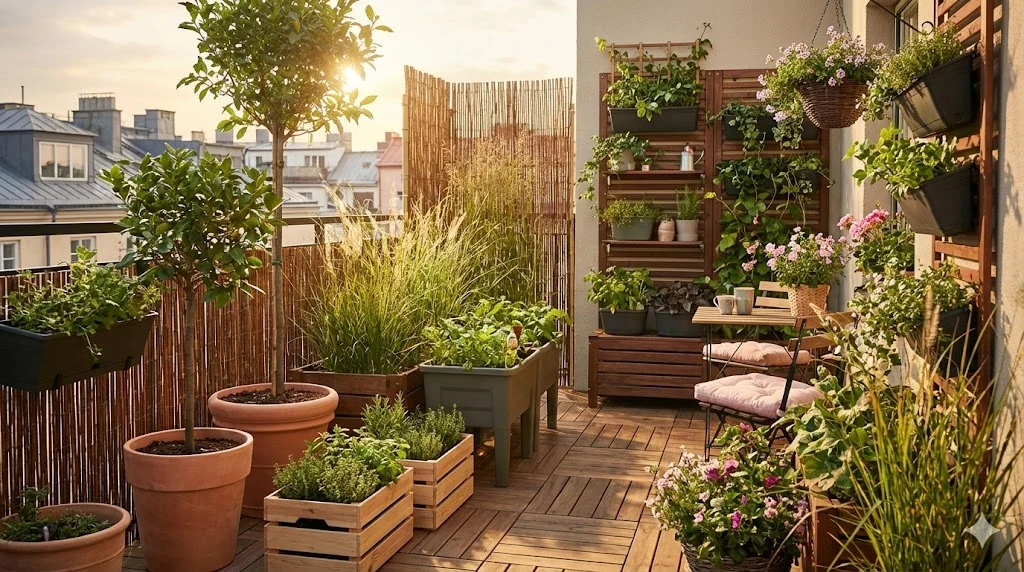
A balcony garden proves you do not need ground to grow a garden. Even a two-metre-by-one balcony accommodates a surprising amount of planting in containers, transforming a flat from merely indoors to something richer.
Weight is the primary constraint -- wet compost in terracotta pots adds up fast. Lightweight containers and soilless media are essential. Wind is the second concern: the higher the balcony, the more exposed. Despite this, herbs, salad leaves, dwarf fruit trees, ornamental grasses, and trailing pelargoniums all perform well. Vertical space -- railings, wall-mounted pots, trellises -- extends the growing area far beyond the floor.
Best for: Flat and apartment dwellers, anyone who wants to garden without a traditional plot.
Read the full Balcony Garden Design Guide -->
Rooftops
A rooftop garden sits at the intersection of ambition and engineering. Above the streetscape, you gain full sun, panoramic views, and a blank canvas. But you also face structural weight limits, extreme wind, and the practical challenge of getting materials up to the roof.
The best rooftop gardens embrace these constraints. Lightweight raised beds, wind-filtering screens, and tough drought-tolerant plants create spaces that genuinely thrive. Architectural plants -- ornamental grasses, Phormium, Agave in mild climates -- provide structure against the sky. Lit by carefully placed spotlights, a rooftop terrace is one of the most atmospheric places to entertain.
Best for: Urban properties with accessible flat roofs, anyone seeking a dramatic elevated garden space.
Read the full Rooftop Garden Design Guide -->
Unique Shapes and Orientations
Not all gardens are simple rectangles. Corner lots, L-shaped plots, north-facing sites, and wraparound gardens all present layout puzzles that standard garden advice does not address. Understanding the specific geometry and orientation of your space is essential to creating a design that uses every square metre well.
Corner Lots
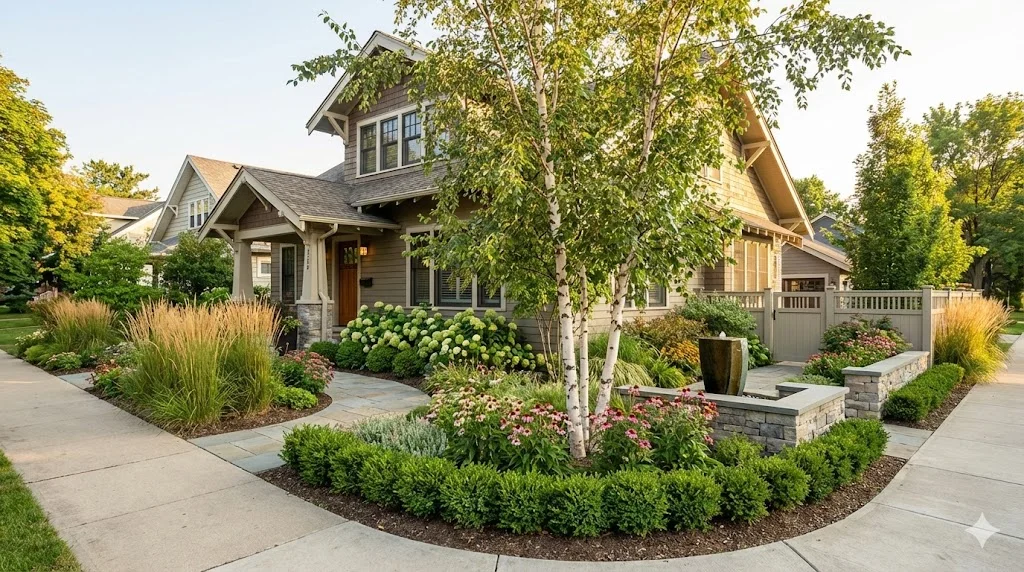
A corner lot garden has two public frontages -- twice the kerb appeal opportunity, but also twice the boundary to design. The corner position often means more sunlight but less privacy.
The most effective designs treat the two frontages differently. The primary frontage gets more formal planting; the secondary can be relaxed or functional. The corner itself is a natural focal point -- a specimen tree or bold planting composition works well. Privacy strategies include layered planting at varying heights and positioning private spaces behind the house.
Best for: Suburban homes on corner plots, anyone who wants to maximise the visual impact of a two-frontage property.
Read the full Corner Lot Design Guide -->
L-Shaped Gardens
An L-shaped garden has a hidden asset: the part around the corner is concealed from the main view, creating a natural opportunity for a "secret" area -- a quiet retreat, a kitchen garden, or a play space. The challenge is making the transition between the two legs feel natural.
Treat the bend as a feature, not a problem. A focal point at the turning point -- a tree, an arch, a change in level -- draws the eye around the corner. The two legs can have entirely different characters: formal entertaining in the wider leg and naturalistic planting in the narrower one. The L-shape is naturally suited to surprise and sequence.
Best for: Properties with an L-shaped or irregular rear garden, anyone who wants distinct garden zones without building physical dividers.
Read the full L-Shaped Garden Design Guide -->
North-Facing Gardens
A north-facing garden receives significantly less direct sunlight, and this shapes every planting and design decision. In winter it may receive no direct sun at all; in summer, the sun may only reach certain areas for a few hours.
Shade is not the enemy -- it is simply different conditions to design for. Some of the most beautiful gardens are shade gardens: woodland paths carpeted with bluebells, lush fern-filled borders, the elegant architecture of Hydrangea and Fatsia japonica. The key strategy is maximising whatever light you receive. Light-coloured walls reflect available light, strategic pruning removes unnecessary shade, and placing your seating where it catches the most sun ensures you enjoy warmth when it appears.
Best for: Any north-facing plot, gardens in the shadow of buildings or tall boundaries, shade-tolerant plant enthusiasts.
Read the full North-Facing Garden Design Guide -->
Wraparound Gardens
A wraparound garden extends around two or more sides of your house, creating a continuous outdoor space accessed from multiple rooms. Each section can serve a different purpose while remaining part of a connected whole -- the kitchen side becomes a herb garden, the living room side a contemplative border.
When you plan the layout for each section of your wraparound garden, you can see how the zones connect. Continuity is crucial: repeating key materials -- the same paving, the same edging, one or two signature plants -- creates unity even when sections have different characters.
Best for: Detached houses with garden access on multiple sides, anyone who wants to create distinct outdoor zones connected to specific indoor rooms.
Read the full Wraparound Garden Design Guide -->
Getting Started
Every garden space, no matter how challenging, holds potential. The side yard you walk past every day, the steep slope you have been mowing at a dangerous angle, the balcony where you keep meaning to put some pots -- all of these are gardens waiting to happen.
Start with observation. Spend time in your space at different times of day and in different seasons. Notice where the sun falls, where the shade lingers, and where the rain collects. Next, measure carefully -- knowing the exact dimensions gives you the foundation for every design decision. Then, identify your priorities. Be honest about how you want to use the space. If privacy is your main concern, address it first; everything else flows more easily once you feel comfortable in your garden.
Finally, follow the links throughout this article to the detailed guide for your specific space type. Your space is unique. Design for it, not despite it, and you will create a garden that belongs nowhere else but where it is.
Garden Design Team
Expert garden designers sharing tips, inspiration, and practical advice for creating beautiful outdoor spaces.
Explore professional garden design
Scapiera is a paid professional garden-design application. See plans for included capabilities and availability.
Join the waitlistRelated articles
Backyard Garden Design: Creating Your Outdoor Sanctuary
Design a backyard that works as an outdoor living space. Zoning for dining, relaxation, and play, with privacy screening and year-round planting.
Balcony Garden Design: Growing in Containers
Create a thriving balcony garden with smart container choices, wind-resistant plants, vertical systems, and self-watering solutions for high-rise growing.
Corner Lot Garden Design: Two-Sided Curb Appeal
Design a corner lot garden that impresses from both streets. Dual frontage planting, visibility sightlines, wraparound beds, and privacy from two directions.